Search This Blog

Tuesday, July 2, 2024

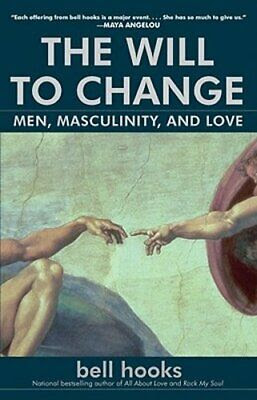
The Will to Change: Men, Masculinity, and Love by bell hooks

        Instead of Andrew Tate or Roosh V. or Sneako or whoever the manosphere is currently worshipping, vulnerable young men need to read this book instead.

Devotees of the blog will know that bell hooks never misses. She’s thoughtful and she’s revolutionary. With this book, The Will to Change: Men, Masculinity, and Love, hooks brings together themes from a few other projects, including All About Love and we real cool. The project explores the ways in which patriarchy limits men’s capacities for fulfilment, especially within relationships. Since hooks is consistently intersectional, you’ll also see that she addresses issues of class, race, and orientation to varying degrees.


The central thesis of the book is essentially that patriarchy destroys men’s capacities for love and each chapter explores ways in which that happens. There’s somewhat of a narrative framing the theoretical components of the text, supplemented by details from hooks’ life. Of particular note is hooks trying to grapple with the idea of desiring a life without her father, free of constraint and liberation from a troubled man, while still trying to build a capacity for love. The work is deeply human in that respect.


While the entire book is valuable and worth reading, I would point to two sections in particular as necessary for combatting the toxic messages in the manosphere.


It’s of surprise to nobody that the manosphere is deeply misogynist, simultaneously degrading women for their sexual behaviours and bragging about their “kills” (yes, that is horrific slang). There is no sense of introspection or empathy in their conversations around women’s bodies. As hard as it may be, there needs to be some sympathy for these lost boys—hooks explains how patriarchy crushes intimacy. Forms of intimacy and connection for men are eroded and so sex comes to serve as a replacement. It’s the only form of intimacy available to men in a society that refuses to let men be vulnerable.


To me, it’s incredible to see that hooks and so-called “men’s rights activists” voice the same kinds of concerns (poorer mental health for men, unfulfilling relationships, etc.) and yet come at it from such different directions. For the manosphere, the guilt lies on women—they are the ones that are simultaneously oversexed and withholding, they are the ones that go for toxic guys (and therefore we must become toxic), they are the ones that offer no support to men. hooks, though, clearly and persuasively points her finger at the systems which create the context for these issues to arise. Patriarchy has created a context and reinforces the barriers to clear expression, connection, and intimacy. Again, young men need to read this book.


The other section that I find so compelling is how hooks discusses the excessive connection men have with their work, to which I readily confess I am a culprit. She notes how men are so connected to their work that they neglect other relationships and meaningful connections in their lives (guilty!). On the one hand, men are rarely valued for themselves and instead for what they contribute to the capitalist machine. The other supposed benefit is that overworking within a capitalist misogynist White supremacist patriarchy is that it prevents introspection—a challenging and often painful process. If men are continually working and unable to introspect on their condition, they are more likely to continue working and align their complete value with their work rather than their intrinsic work as people. Is it any wonder that men buy into hustle culture and crypto and rank themselves as Alphas, Betas, Chads, Sigmas, and so on? All of these are quantifiable forms of value for men who can’t receive and accept love like love. 


The central issue I suspect many people will have with hooks’ work, and one from which I’m not immune, is the lack of actionable items. The Will to Change is more practical than most of her works, but still is less direct than one might hope. There are no easy “12 rules for life,” as it were. All of the actions require your own thoughtfulness and agency to enact in practicable terms. hooks offers more of what some might call guidelines, or a general map. The actual route is your own.


This review may come across as short, but don’t misunderstand: it is not because the book does not have enough weight to offer more substantial commentary. Instead, it’s just such a poignant reflection on the state of masculinity today—and yesterday—that it’s hard to find fault or offer thoughtful commentary. hooks is simply right, particularly because her work liberates men from harmful mindsets and encourages sympathy for those struggling while still holding them to account for their behaviours.


In short, if you or a man you know is struggling with issues related to loving relationships (not necessarily romantic), or if you have a young man in your life who is in the process of growing up, help guide them with this book. Give them a copy. Talk to them. Help fight the real enemy (patriarchy) with kindness and care rather than letting men point their fingers at their classmates, their sisters, their moms, their girlfriends, their spouses, their daughters. Patriarchy is the problem and always has been.


Happy liberatory reading, folks!

Symptômes by Catherine Ocelot

    The opening of Catherine Ocelot’s graphic novel Symptômes is fantastic. Ocelot begins by celebrating a new episode of Grey’s Anatomy airing. She then confesses, though, to hypochondriac tendencies and illustrates all kinds of amusingly terrible maladies, to which the doctors, without fail, respond, “ok! We’re going to operate!” The scan reveals a spontaneous decomposition of his organs: we operate; a parasite is turning a person’s skin into tree bark: we operate; my eye fell out and my mom put it in a ziplock bag: we operate. The tone and style of the book is communicated so wonderfully in just a few pages it’s hard to resist its allure.

While the main character is undeniably Ocelot, a number of different vignettes comprise the whole of the novel. There are six women united by being part of, essentially, “Lonely People Anonymous.” Each tells their story and there’s a great deal of tenderness and humour in the approach, culminating with Ocelot getting surgery while the other women watch on and debate whether to smile at the surgeons, eating muffins, and then saying “hey the surgeon is looking, smile now!” and then being presented in a very funny panel with no text.

In fact, Ocelot’s visual storytelling is impeccable. First, her art style is free and easy, casual even—and yet, it looks like it was done, colour and all, with pen, which probably took far more hours than first appears. The art style also ranges from sparse to explosively surreal, but it consistently has a softness to it that elevates the storytelling. In case it’s unclear from the title, Symptômes is in French and French is not my first language, so the visuals were a great addition (or even replacement) for text, and some of the chapters were completely text-free. One short chapter shows two women standing ankle-deep in water; one woman is crying and the other woman is holding onto her. As the woman continues to cry, the water becomes more forceful and the woman hanging onto her is pulled away. The woman continues to cry and the other woman disappears under the water and is pulled away. It feels like a tragic allegory. In another wordless chapter, there are two women sitting by water while beautiful, multi-coloured ducks and birds drift by. One woman seems to be speaking about peacocks and crying and the other woman consoles her and goes through a transformative process, becoming a multicoloured bird herself until two gigantic peacocks appear before them on the horizon. In another nearly wordless chapter, a woman takes care of a house plant for a man who says nobody had ever devoted so much attention to his plant. The two sleep together and he asks her to stay the night; there’s a tenderness between them before she gets up in the middle of the night, puts on her winterwear, and leaves his house, leaving the plant she cared for framed in the window. Ocelot matches the visual style of the chapters to the stories they’re telling and, even without words, she creates such beautiful, tragic stories of loneliness, regret, and isolation.

The text and images can often pair to create the humour of the book, as well. I already mentioned the funny scene at the side of the operating table, but there’s also a scene where Ocelot is at the doctor listing things that are wrong with her. He essentially says that she’s a hypochondriac and needs to stop thinking about her body. The perspective then changes to Ocelot’s point of view. As the doctor says she needs to stop thinking about her body, you see his face and then all kinds of medical charts on the wall documenting the parts of the tongue, the foot, the upper body organs, and so on. Ocelot’s acerbic wit is just perfect comedic timing.

One of the scenes I think might resonate with a lot of people is when Ocelot voices a theory about everyone being connected by threads, reminiscent of Jane Eyre. Ocelot says that there are threads running between everyone and that’s why we have feelings of being watched or that we’re going to run into someone. The chapter follows colourful threads and builds towards a beautiful scene of her laying in a hammock made of the threads connected to others. The message is that when you have connections to many people, you’re able to rest easy in a hammock of their support. Then, you turn the page and see people wrapped in thread, being squeezed as people have trouble connecting. It’s a lovely chapter that could stand alone, but thematically works in this collection.

Overall, I really enjoyed this book. Between the art style, the clever writing, the loving care towards the characters, the humour, and the touching themes, the graphic novel has a lot to offer—not to mention that I was able to read it in an afternoon. I thoroughly enjoyed it.

Happy reading!

Saturday, June 29, 2024

Dark Constellations by Pola Oloixarac

  Pola Oloixarac’s book Dark Constellations is not so much a novel as a concept. Spanning three narratives over 142 years and condensed into a tight 202 pages, its cover review from AV Club touts that the book is “galactic in the stretch of its narrative ambitions.” The size of these ambitions, though, prevents the novel from feeling like any kind of story. It’s a speculative work that tries to combine so many underdeveloped concepts, which meant that by the time I had fifty pages left, I was dying for Oloixarac to just get on with it and bring the separate storylines together.

Sometimes a passing allusion gives a significant clue to a text. In this case, a passing reference to William Gibson’s Neuromancer hints at the aesthetic of the book, and, in my opinion, both books have a similarly alienating approach. There’s a kind of rapidity to the works, flashes of technological innovations that readers are immersed in without context, and producing a kind of whiplash of world-building. Admittedly, I’m betraying a lack of willingness to engage in challenging reading. Not that I want to have everything explained through exposition dumps, but the sheer number of concepts, characters, and decades is so alienating that the whole project of the book leaves me feeling cold and indifferent.

I’ll provide a brief summary here. I may have a number of details wrong.


Oloixarac presents three narratives. The first takes place in 1882 with a group of researchers (botanists? entomologists? evolutionary biologists?). From what I can tell, it involves a discovery of a kind of drug-like transcendence produced by licking flowers? It also seems to involve a kind of gross creature that burrows into peoples’ skins and then alters their minds. There is also maybe some kind of supernatural being or alien in an underground cave—is it a metaphor or literal? The second stage of the book takes place in 1983 and is focused around Cassio, the most developed of the endless train of characters. He is a budding hacker who works his way through systems and implants viruses. As his career continues, it seems that he has an idea of combining technology and living beings and later seems to be the human key to initiating a computer virus that crashes the economy briefly—that part takes place in 2024 and focuses on Piera, sort of, I guess. There’s some stuff about rats disguising themselves in human bodies, tracking the “dark constellations” of negative space in rat-movement patterns, a mass-surveillance system that seems to rely on olfactory knowledge of DNA. Everyone is always trackable at all times, despite the fact that humans are never single entities (the book notes that there is more bacteria in humans than whatever we consider as an identity).


I think the book is marred by several central flaws. First, there are too many characters and they come across as empty husks. Even at the climax of the book, Cassio’s betrayal of his company by unleashing a virus days before they sell the company is so obscure in its motivations that it fails to address the second of the central flaws (namely: it feels like there are no events.) I wouldn’t expect myself to align with Stephen King very often, but I recall he once gave writing advice that nobody cares about characters: people care about events. If the characters don’t do anything, there’s no reason to care about them. Oloixarac seems to ignore this advice, or rather I was so bewildered by everything happening in the book that it felt like nothing happened. These two issues contribute to the absolute core one: the novel lacks cohesion. The timeframe jumps around with very little overlap (with one exception being that Cassio and Piera work with one another)—and in fact, even the Cassio section span several years, so the timeframe is not clearly demarcated. The connection between licking plants and human viruses and olfactory surveillance systems is never explicitly addressed; it’s a sketch; it’s nodes of ideas—oh darn, it’s a constellation, isn’t it?


What makes the book interesting is its sociological bent. While again not feeling fully cohesive in the book, there are flashes of sexual politics inserted throughout that are engaging in their own right, if not fully explored in its implications for a posthumanist project. The posthumanist plurality of identity is worth exploring. The idea that none of us is singular, that we are influenced by other beings inside us, is a compelling premise that finds home in Dark Constellations. As I mentioned, I’m not entirely clear on whether aliens are real in the context of the novel. The way Oloixarac describes characters suggests alien inhabitation of their bodies, though reading it as a kind of techno-Marxist metaphor would be equally appropriate. Actually, referring back to the sexual politics of the book, I would say this alienation produces some of the grossest descriptions of sex I’ve read in a book: it’s a dissociated alien-like depiction that seems both medical and completely disgusting.


Overall, I have to say Dark Constellations has an interesting premise in exploring the morphing nature of symbiosis between humans and other entities, including technology as the next frontier, but ultimately leaves me scratching my head. Dark Constellations are the gaps between stellar configurations, a darkness the technophiles of the book are mapping (and thus erasing?) at the same time. The style of the book emulates those dark constellations: it feels like everything important about the book is happening between what is actually written. I started to read some reviews to see what other kinds of summary details would supplement my review, but even starting to read reviews I couldn’t help but feel: this isn’t worth my time. There isn’t enough there there.


Over and out.