Search This Blog

Showing posts with label masculinity. Show all posts

Saturday, October 4, 2025

H of H Playbook by Anne Carson

  There will come a day, or series of days, when I finally stop confusing Anne Michaels and Anne Carson, but that day hasn’t yet arrived. The last time I read Anne Carson was when I picked up The Autobiography of Red, and when my partner and I saw the format of H of H Playbook in the poetry section of a book store, she picked it up immediately, knowing nothing about it.

The reason for that is because H of H Playbook is an oddly shaped rectangle that opens up to part play-script part scrapbook part art collection. That’s one of the highlights of Carson’s book: there’s a haphazardness to it, as though these fragments are compiled from an ancient manuscript for a play about Herakles lost to time. In fact, one of the opening pages denotes the book as a translation of Euripides’ play first performed in 416 BC—a statement that quickly becomes ludicrous when reading the rest of the text.

Carson’s “translation” is replete with modern colloquialisms and allusions to events that happened centuries after Euripides’ death. In particular, there are references to Jane Austen and the Bolshevik revolution, and so on. This approach gives the book a whimsical freshness that helps to enliven the classic tale, which is, in my view, in need of it.

I’m not a classicist. I know very little about the ancients and discussion of Greek gods often slips through my ears. Reading the back of the book was critical for me to really process the book. Herakles is a hero who goes off on labours to defeat enemies and kill monsters and whatnot. The book makes reference to about two of them explicitly and then glosses over the other ten as boring retrod ground. Apparently, Herakles also went beserk and killed his whole family before considering suicide. In Anne Carson’s version, it’s somewhat implied that he has PTSD and that he has a psychotic episode in the same way a Vietnam veteran might. At the same time, it’s as though he’s controlled by malicious Gods. Again, Carson blends the ancient explanations for more contemporary ones.

A number of aspects of the book remain obscure to me. It’s one of those unfortunate things about revising the classics: the commentary and elaboration of the classics is often more impressive to me than the classics themselves, but I also don’t know the source material well enough to make the discussion truly meaningful. So, when the redwinged man shows up or when Theseus shows up to guide Herakles away, the significance is sort of lost on me.

The artwork is what really helps to clarify the spirit of the book. First, the text is presented in small fragments, sometimes isolating a single phrase on a page to elevate its emotive power. The artwork throughout the book embodies a kind of loose style, occasionally depicting sketched human forms and often splashes of colour. Red for violence and blood. Yellow and blue strips when the mood changes. All of them adding to a sense of disorder mimicking Herakles’ disordered misadventures, perhaps.

I’ll have to admit: the story of Herakles is not close enough to my heart for this book to really rock my world. It’s a nice, short book, but one I’m not likely to return to or have linger with me. I appreciate its inventiveness as an experiment and multigenre text and the way it makes time fold over itself. I’m sure there’s a genius at work here; I’m just not smart enough to really let this book thrive.

Happy reading!

Tuesday, July 2, 2024

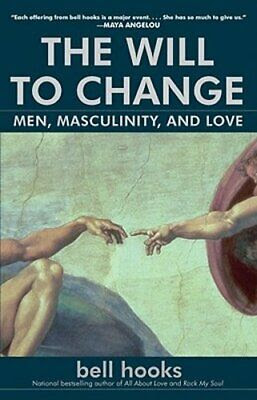
The Will to Change: Men, Masculinity, and Love by bell hooks

        Instead of Andrew Tate or Roosh V. or Sneako or whoever the manosphere is currently worshipping, vulnerable young men need to read this book instead.

Devotees of the blog will know that bell hooks never misses. She’s thoughtful and she’s revolutionary. With this book, The Will to Change: Men, Masculinity, and Love, hooks brings together themes from a few other projects, including All About Love and we real cool. The project explores the ways in which patriarchy limits men’s capacities for fulfilment, especially within relationships. Since hooks is consistently intersectional, you’ll also see that she addresses issues of class, race, and orientation to varying degrees.


The central thesis of the book is essentially that patriarchy destroys men’s capacities for love and each chapter explores ways in which that happens. There’s somewhat of a narrative framing the theoretical components of the text, supplemented by details from hooks’ life. Of particular note is hooks trying to grapple with the idea of desiring a life without her father, free of constraint and liberation from a troubled man, while still trying to build a capacity for love. The work is deeply human in that respect.


While the entire book is valuable and worth reading, I would point to two sections in particular as necessary for combatting the toxic messages in the manosphere.


It’s of surprise to nobody that the manosphere is deeply misogynist, simultaneously degrading women for their sexual behaviours and bragging about their “kills” (yes, that is horrific slang). There is no sense of introspection or empathy in their conversations around women’s bodies. As hard as it may be, there needs to be some sympathy for these lost boys—hooks explains how patriarchy crushes intimacy. Forms of intimacy and connection for men are eroded and so sex comes to serve as a replacement. It’s the only form of intimacy available to men in a society that refuses to let men be vulnerable.


To me, it’s incredible to see that hooks and so-called “men’s rights activists” voice the same kinds of concerns (poorer mental health for men, unfulfilling relationships, etc.) and yet come at it from such different directions. For the manosphere, the guilt lies on women—they are the ones that are simultaneously oversexed and withholding, they are the ones that go for toxic guys (and therefore we must become toxic), they are the ones that offer no support to men. hooks, though, clearly and persuasively points her finger at the systems which create the context for these issues to arise. Patriarchy has created a context and reinforces the barriers to clear expression, connection, and intimacy. Again, young men need to read this book.


The other section that I find so compelling is how hooks discusses the excessive connection men have with their work, to which I readily confess I am a culprit. She notes how men are so connected to their work that they neglect other relationships and meaningful connections in their lives (guilty!). On the one hand, men are rarely valued for themselves and instead for what they contribute to the capitalist machine. The other supposed benefit is that overworking within a capitalist misogynist White supremacist patriarchy is that it prevents introspection—a challenging and often painful process. If men are continually working and unable to introspect on their condition, they are more likely to continue working and align their complete value with their work rather than their intrinsic work as people. Is it any wonder that men buy into hustle culture and crypto and rank themselves as Alphas, Betas, Chads, Sigmas, and so on? All of these are quantifiable forms of value for men who can’t receive and accept love like love. 


The central issue I suspect many people will have with hooks’ work, and one from which I’m not immune, is the lack of actionable items. The Will to Change is more practical than most of her works, but still is less direct than one might hope. There are no easy “12 rules for life,” as it were. All of the actions require your own thoughtfulness and agency to enact in practicable terms. hooks offers more of what some might call guidelines, or a general map. The actual route is your own.


This review may come across as short, but don’t misunderstand: it is not because the book does not have enough weight to offer more substantial commentary. Instead, it’s just such a poignant reflection on the state of masculinity today—and yesterday—that it’s hard to find fault or offer thoughtful commentary. hooks is simply right, particularly because her work liberates men from harmful mindsets and encourages sympathy for those struggling while still holding them to account for their behaviours.


In short, if you or a man you know is struggling with issues related to loving relationships (not necessarily romantic), or if you have a young man in your life who is in the process of growing up, help guide them with this book. Give them a copy. Talk to them. Help fight the real enemy (patriarchy) with kindness and care rather than letting men point their fingers at their classmates, their sisters, their moms, their girlfriends, their spouses, their daughters. Patriarchy is the problem and always has been.


Happy liberatory reading, folks!