Search This Blog

Saturday, December 30, 2023

Trust the Plan: The Rise of QAnon and the Conspiracy that Unhinged America by Will Sommer

    Unfortunately, I failed to keep notes while reading Will Sommer’s Trust the Plan: The Rise of QAnon and the Conspiracy that Unhinged America. Perhaps it was because I was engrossed by the absurdity of reality, or perhaps I was just lazy, but I fear that either way I’m going to be offering a pretty sparse review for this one.

Trust the Plan is essentially a book-length piece of journalism exploring the rise of QAnon, as advertised in the title. Sommer tells the story, essentially, from QAnon’s origins to the present in a basically linear fashion. The book presents the information through a mix of investigative journalism, human interest stories, and case studies of QAnon’s power. I’m not sure why Q retains such power over the collective imagination; even I, who believes that the situation is fundamentally absurd, nonetheless want to know who Q is.


But of course, there is no Q. Q is everywhere and nowhere.


I’m getting ahead of myself.


The rise of QAnon is patently absurd, its claims patently ridiculous, and yet it’s one of those situations where truth is stranger than fiction. Perhaps that’s why people are so willing to invest their energy into QAnon conspiracies. Sommer traces the origins of Q to a 4Chan message board. The fact that Q gained prominence by posting cryptic anonymous messages to a garbage website is somehow both astounding and entirely appropriate. In an unlikely comparison, I’ll actually bring up Hamlet here, as I do in all cases when I’m able. When Ophelia goes mad, a gentleman in the court reports on her behaviour to Gertrude: “she hears / There’s tricks i’ th’ world [...] speaks things in doubt, / That carry but half sense. Her speech is nothing, / Yet the unshaped use of it doth move / The hearers to collection; they aim at it, / And botch the words up fit to their own thoughts.” Essentially, Ophelia says things that “carry but half sense” — there’s a lack of logic in what she says. While her speech is “nothing” (i.e. devoid of meaning), people are able to “fit” her words to “their own thoughts.” People find meaning in her words precisely because they are so unformed. I can’t help but feel that there’s a similar kind of madness at work in Q—an infectious madness where people find meaning in small clues that mean nothing.


Despite its complete lack of logic, Q’s arrival into the political sphere was the result of a perfect storm. With burgeoning online communities like 4Chan, Reddit, and so on, more people are able to have a voice than ever. With the greed of tech companies comes the lack of restrictions on what can and cannot be said. With the distrust in media, people look for other outlets for truth. With the world seemingly worse than ever and with capitalism’s power to pit people against the wrong targets, people are desperate for explanations: how did we get here? What is to be done?


First of all, I think some of the blame lies on the founders and moderators of 4Chan and 8Chan. To its credit, 4Chan did start to implement some restrictions on what could be posted, but far too late. People had already built community around looking for the latest Qclues following Q’s first post of vague lucky guesses and “correct” predictions (that is, if you project meaning into them retroactively—like a political horoscope vague enough to accept as true…). When they cracked down on political posts like Q’s, 8Chan was made available—a similar anonymous message board with even fewer restrictions. The market allows for, and even encourages, a lack of restrictions (up to a point—cf. Twitter), which allowed the QAnon community to grow.


What is truly baffling, though, is how people refuse to accept reality. The most obvious example is probably Pizzagate, where a random pizza parlour was accused of harbouring abducted children in its basement and engaging in truly depraved behaviour towards them. The case was investigated, and the pizza parlour was found to not even have a basement. You would think that claims that are so easily refuted would lead to a lack of confidence in Q, but the paranoiac mind always finds an explanation. It’s always that someone alerted them or that law enforcement is in on it or some other kind of nonsense, or that a plan was meant to fail because there’s an even deeper plan you can’t understand at work. When your enemy has unlimited satanic power and your ally has unlimited knowledge, there’s always an explanation.


Sommer outlines a number of truly depressing case studies that follow from this framework. Peoples’ families are torn apart by Q’s lies and Sommer delves into people who faced ruin or even criminal charges due to their commitment to Q, a hero that will never save them. The case studies often speak to broader trends—people feeling financially, educationally, relationally, or politically disenfranchised gravitate towards the conspiracies that give them a sense of power. They know. They have the capacity to be an expert just by reading the clues. In a few cases, Sommer interviews people who were able to escape Q’s influence, but I fear that more people continue to recommit to the cause than escape it. Besides, even when people escape QAnon, the transition back to a regular life cannot be easy.


Of course, there are real-world consequences for the QAnon phenomenon. It was interesting to see the relationship between Donald Trump and Q develop. Initially, the GOP really tried to distance itself from Q. They saw the kinds of things people were saying and how they were seen as the ‘crazies.’ Trump was advised to not comment on Q whatsoever, but of course he can’t help himself, so when Q started voicing ideas that were pro-Trump or aligned with his values, he just had to start parroting some of their ideas as talking points. Of course, that fueled wider acceptance of Q and the Trump campaign entered into an unholy alliance, so much so that other politicians would actively use Q to leverage their own campaigns. You could draw on the radically disenfranchised vote by capitalizing on conspiracy theories—whether you intended to do anything about it or not, it was a cheap trick for getting elected as opposed to your more moderate competitors. 


So far, QAnon has been promoted for economic reasons (driving clicks, driving interest in the message boards, etc.) and political ones (using extremism to capitalize on votes). Sommer shows how it destroys families, but also how it attacks its opponents. There are several instances of Sommer attending conferences with significant Q presence. In one excursion, he outlines his disguises and false names to avoid detection. He talked about how the conferences would fuel extremism, too. When QAnons sees enemies everywhere in its conspiratorial outlook, the impulse is to one-up and out-crazy your fellow QAnons. You always have to prove your commitment. The scene is an interesting one, particularly because you don’t know quite whether Sommer is going to be caught and what kind of danger he is placing himself in.


The book does a great job of documenting where Q came from, its escalation, its use of confirmation bias to assure itself of its own position, and so on. In my opinion, there are two areas that are somewhat lacking in Trust the Plan—one being more excusable than the other. In the first case, I would have liked some more guidance on how to disrupt the misinformation campaign. Unfortunately, people being exposed to the truth is generally not enough. When you’re firmly committed to a conspiracy, counterevidence stops being relevant. It was a trend among those afflicted with QAnonism that they said nobody could convince them otherwise and that if they were presented with facts that contradicted their point of view, it would only make them dismiss their interlocutor as ignorant and / or bolster their own views—“look how powerful the Satanists are that people believe these facts! They don’t know how deep it goes!”


So I’m left with a question: what can we actually do? If facts and knowledge don’t counteract, where does that leave us? Sommer gives a cursory solution. Essentially, it involves showing compassion to those who have fallen prey to the misinformation while better promoting social services. When people are isolated and struggling, they are more likely to succumb to the traps of conspiratorial and paranoiac thinking. I’m sure Sommer is right in that, but it doesn’t provide an actionable toolkit for us regular folk just trying to make a difference. I wish there had been more thorough exploration of how to combat QAnon.


The other issue that I would have liked to see more of is investigation into who Q actually is. In some ways it’s a useless question, because there likely isn’t an actual Q. Probably it started as one person’s joke and then it was taken up by someone else and then it spiralled out of control. When considering the movement, Q can be both everyone and no one like the most awful version of Spartacus. Q gained global momentum for some reason, and Germany has the most Q supporters outside of the U.S., not a little alarming given Q’s ties to antisemitism.


Overall, Sommer is an effective journalist and writer. Trust the Plan has a good balance of reportage and offers an effective overview of the rise of Q. While there are some areas that could have been more penetrating, it was a reasonably informative work that helps to explain the terrible phenomenon of QAnon.


My hope is that books like this will inoculate us against similar conspiracies, but only time will tell. Time and my crossed fingers.

Friday, December 29, 2023

Getting Gamers: The Psychology of Video Games and Their Impact on the People Who Play Them by Jamie Madigan

        From my youngest years, I remember playing video games: early mornings, late nights, moments of frustration, defeat, and triumph—luckily, sometimes, in that order. I remember long mornings of practice so that I could finish Mega Man 6 or, later, the feeling of grinding through Earthbound or Super Mario RPG, or loading an emulator of Final Fantasy V or Chrono Trigger and being stunned by the colourful sprites, or, later, trying to speedrun Resident Evil 2 after having memorized the spawn points for enemies and puzzle keys.

Despite this love, though, I am forced to recognize that my love of gaming does not always bring out my best qualities. I still have a scar on my head, for example, from when, as a child, I slammed a Nintendo against myself in frustration. More existentially, I recognize that I’m largely risk/choice-averse and, reflecting on this in my grade 12 year, I couldn’t help but feel that that was connected to my propensity for ‘saving my game.’ If I made a mistake, I could just go back and try again. In real life, though? If only! They also tend to fuel my addiction to productivity; rather than stop playing when I stop having fun, I have to be a completionist, beat every level and earn every achievement before I can consider myself a success (and get down on myself if I don’t finish.)


All this to say, it’s difficult to measure how much of my choice to read Jamie Madigan’s Getting Gamers: The Psychology of Video Games and Their Impact on the People Who Play Them is a self-interested attempt at self-understanding and self-help, an academic interest to explore a cultural phenomenon, or an attempt to build my resources for a video game course I intend to teach next year. Regardless of motive, though, Madigan’s text serves as an excellent primer to the relationship between our minds and gaming. For full disclosure, I should mention that I’m writing this review months after finishing the book, so some of the details that were more immediate have faded away. If this review seems somewhat thin, I accept all the blame—I feel like every chapter of Madigan’s book had something worthwhile to offer.


The range of the text is pretty strong, if leaning a little heavily on the sociology of games. Rather than an individualistic psychology (which is there), for better or for worse Madigan focuses on collective experiences and the gaming industry. A selection of chapters in the book includes: 1. Why Do Perfectly Normal People Become Raving Lunatics Online?, 3. Why Are Fanboys and Fangirls So Ready for a Fight?, 4. Why Do We Get Nostalgic About Good Old Games?, 6. How Do Games Get Us to Grind, Complete Side Quests, and Chase Achievements?, and 10. How Do Facebook Games and Smartphone Apps Get You With In-Game Purchases?


What is interesting about Madigan’s book is that, in most cases, he is drawing from diverse psychological studies that are unrelated to the gaming industry and then looks at how “human nature” (I always use that term with reservation) manifests itself through the avenue of gaming. For instance, he talks about an experiment where young boys were sent to a summer camp in separate busses and given team names. By the time they reached the camp about an hour and a half later, they had already solidified group identities and it produced antagonisms immediately. Madigan then connects that to the phenomenon of group identity online, the competitiveness of online games, and so on.


Games, in many ways, feed addiction. What I found really surprising, though, is how we can manipulate situations for the better. For example, when monitoring people cheating in online games, there was some reduction of cheating if players received an on-screen reminder immediately before a match to not cheat. There was a marginal improvement, too, when they changed the language. Being reminded not to cheat? Meh. Being reminded not to be a cheater? Well, there’s something that defines your identity. People can justify a behaviour, but it’s harder to justify their being. I’m already considering how I could use this to my advantage pedagogically: “Don’t plagiarize” orrrrrrrr “Don’t be a plagiarist!” In this sense, games become an avenue for exploring social phenomena and can be leveraged to build better communities.


There are actually a number of incentives that I could see myself using in an educational context—in fact, I already have. In the chapter “How Do Games Get Us to Grind, Complete Side Quests, and Chase Achievements?”, Madigan talks about how games motivate you to complete quests by only revealing the quest once you’ve already started. For example, if you need to collect 10 diamonds, it will only tell you about the quest after you already have the first one. In that model, the likelihood that you’ll complete the quest skyrockets because you’re already invested. I’m doing that with my assignments: students are completing their brainstorming or a free-write to get ideas down, or completing an opening paragraph before I even tell them what the final product assignment will be. I can’t say it’s working quite as well as it does in video games, but still, it’s worth a shot!


The idea of quests, grinding, and achievement are all of profound interest to me. When I think about my favourite games, or the games in which I spend the most time, it’s all about watching those numbers go up. I’m somewhat ashamed to admit that I get addicted to JRPGs quite often, particularly the Tales Of and Star Ocean franchises. I suspect that I find myself so entrenched in those games because there are so many things to do. There’s the main quest, sure, but there are always a plethora of side quests, plus achievements, plus metrics to max out: character level, skill levels, affinity levels, and so on—and with parties of 6 or 8 characters, there’s always someone levelling up. It’s hard to put down the controller where you see visible, quantifiable progress every few minutes. If only real life was like that.


Madigan links this idea to Self-Determination Theory. He begins by referring to a study that found that players “are attracted to achievements and quests [because] [...] they want to experience achievement through progress, power, accumulation and status within  game.” The achievement motivator researcher suggested that he could pick out what type of gamer people were based on a simple survey and that he could “predict how many hours someone is likely to spend with a game” based on how well it satisfies our need for achievement. That certainly holds true for me, as does the downside that Madigan identifies: “the competitive or grinding aspects of achievement may also lead them to be in a slightly worse mood.” There’s something Freudian in continually returning to pain, but you’re always chasing that high of ‘completion’ that comes so infrequently. So yes, I get down after wasting a few hours trying to max out a character stat but then just have to hope I feel accomplished in some impossible future.


When explaining the connection to “self-determination theory,” Madigan explains that people engage in voluntary behaviour because of competence, autonomy, and relatedness. Namely, they want to feel that they are competent, that they have meaningful choices in how to express that competence, and the need to feel connected to others in the process. Video games provide that space in a way that few other mediums (indeed, few other interactions) can. Competence can be demonstrated with clear benchmarks (level, score, etc.) and the interactivity of the medium provides instant feedback (actually, I remember being at a conference years ago that addressed the gamification of education and the need for continual immediate feedback…). As for relatedness, we’ve already learned about how team affiliations create a place for people—healthily or not.


There were a number of chapters that were compelling in that respect, though I’m blanking on a number of the details. I remember one chapter discussed the bias we have in favour of decisions we’ve already made. In reference to buying a new console, for instance, people might debate the specs of each before finally settling on one. The funny thing is that after people commit to a decision, they feel more dedicated to that choice as the ‘right’ one, as if our brain is protecting us from the pain of a mistake. That also helps to reinforce group identity (we’re the smart ones because we bought a Playstation instead of an X-Box!).


There were a number of other phenomena that were compelling with respect to group identity, but instead I’d like to spend some time to focus on the idea of individual identity. For more on this topic, I’d recommend the first chapter of Glitch Feminism: A Manifesto by Legacy Russell. Madigan discusses the Proteus effect, meaning that our gaming avatars are not mere ornamentation. “Avatars,” he writes, “alter the identity of the people who use them because players make inferences about what attitudes are expected of them based on their appearance, then are more likely to alter their attitudes and behaviour to match.” If this is true, our avatars ought to be aspirational. We would have the power to decide the people we want to be and how we want to be perceived. Legacy Russell discusses how there is no barrier between ‘real’ life and ‘online’ life, and here we see how the implications of avatars might play out. Players who play Call of Duty, for instance, are more likely to associate the word ‘me’ with words like soldier and pistol while players of Gran Turismo identify more with the word racer or driver. Madigan notes that after playing a game where people inhabit the body of a superhero, they are more likely to engage in helpful behaviour in ‘real life.’


Of course, the negatives of that also hold true. Madigan gives the the example of women gamers occupying bodies that make them more self-conscious of their physical bodies and more likely to side with the false premise that victims of sexual assault are in some way at fault for their own abuse due to what they wear, etc. Again, it requires an ethical commitment to representation—and maybe even selection of our avatars—when playing games.


Speaking of ethics, there’s a fair amount of content here regarding money-making schemes and content. For instance, there’s discussion of games that are essentially pay-to-progress. You can imagine the kind of games that get referenced: the Facebook games that make you wait, the apps that are free to download but that require payment if you want to make more progress than once every three hours, and so on. Madigan does the math and works through the layers of displacement that exist to keep players playing without realizing the cost. For instance, you might need crystals to progress and gems to build structures, and so on. Both crystals and gems can be earned…slowly. Both can be purchased for real money, but there are all kinds of mechanisms to ensure the opacity of the exchange rate. Not only that, but when you buy these currencies, it’s never in even increments, so you’re never quite sure how much you’ve paid and you always end up having more than you wanted but less than you need for the next interval.


In one anecdote, Madigan cites a man who had something like five devices and accounts that he dedicated hours and hours to to make progress in a Farmville-like game. He even had a device in the shower in a ziploc bag so that he could play in the shower. What’s fascinating though is that only about 3% of players will ever spend money on a game and only about 1% of players will repeatedly spend money on a game—but they will spend a lot. It’s wild to think that games can rely on such a small portion of their players to make a return on the investment—the fact that once people do succumb to these games it justifies the developers’ game-mill is astounding.


The most egregious example is a case study Madigan refers to called Cow Clicker, a Facebook game that had one objective: click the cow. All you had to do was click the cow. Then a timer would start until the next time you could click your cow. It was created as a satire of Skinner box games, yet it gained rapid popularity and became a phenomenon, with people buying custom cows. What started as a joke evolved into a moneymaking hit. It was a fascinating story for all of what it might suggest about human psychology.


In between me reading this book and writing this review, I pitched an online course with my school board about video game media that has been approved for the 2024-2025 school year. Provided it gets the enrollment to run, this course will draw on several sections of this book. It has so much to offer when it comes to identity, community, choice, achievement, and a sense of fulfilment. It’s an excellent entrypoint to psychology, sociology, media studies, and video games. It’s accessible in its language, deep in its content, and offers opportunities for a lot of rich reflection. I loved it.


That’s it for now: game over, reader wins.

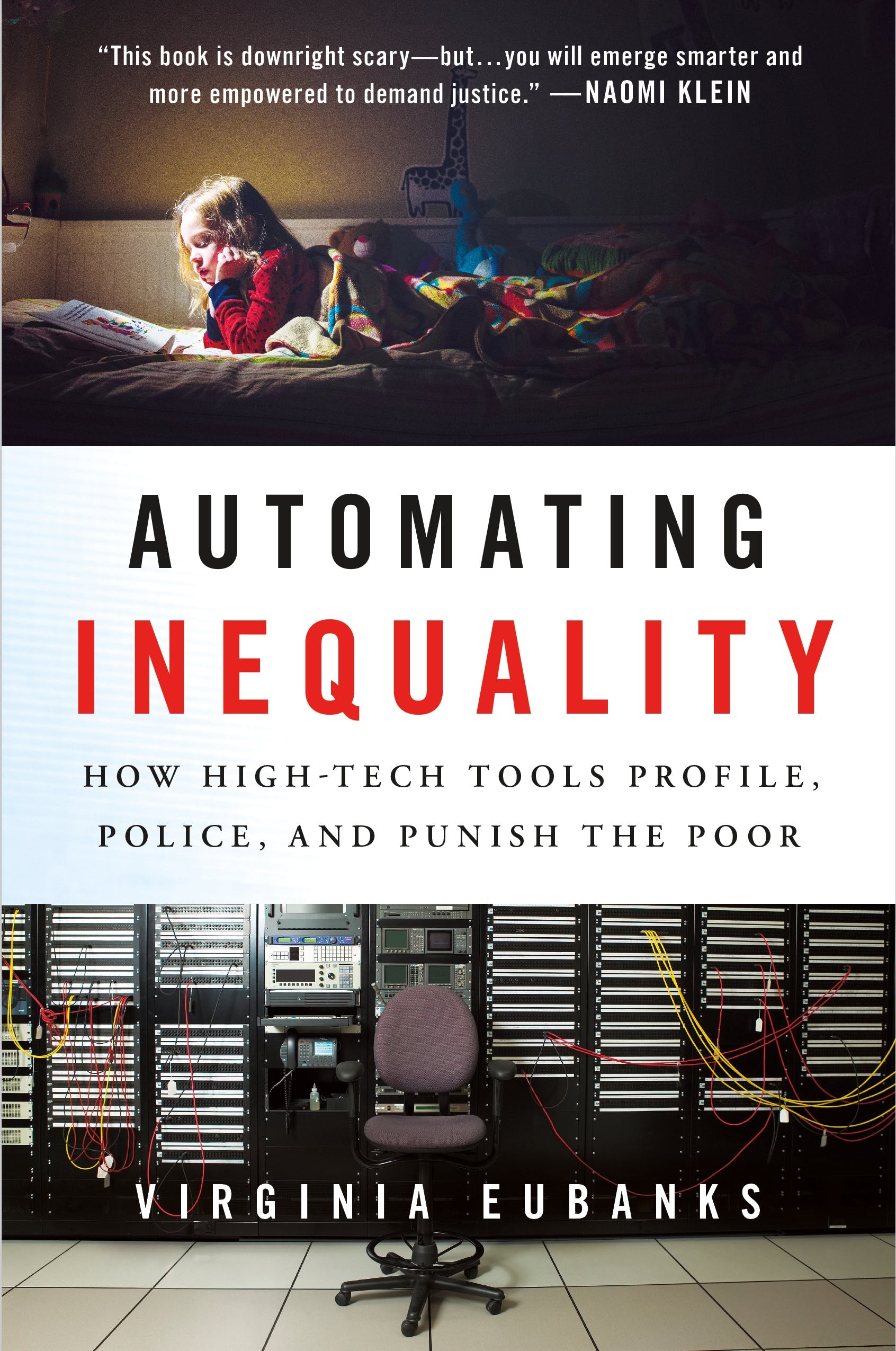
Automating Inequality: How High-Tech Tools Profile, Police, and Punish the Poor by Virginia Eubanks

        I am currently racing against the clock to catch up on all of my remnant book reviews for the year. The temptation presents itself: could I just post an AI review of Virginia Eubanks’ Automating Inequality: How High-Tech Tools Profile, Police, and Punish the Poor? Of course not! If you’ve learned nothing this year from the non-fiction reviews I’ve been posting, it’s that there is significant reason to distrust the automation of thinking, and really, I would be going against the central premise of Eubanks’ book: we need more human intervention, not less.

In Automating Inequality, Eubanks outlines the ways in which technology is used to, essentially, engage in social engineering. The books is a mix of testimonials, public record, anecdotes, case studies, and histories to explore the ways in which the increasing automation of public services has actually served to reduce services and potentially replicate—even exacerbate— the problems the state claims to want to reduce. She makes her case with reference to three main places: Los Angeles, Indiana, and Allegheny County in Pennsylvania. The approach allows her to see both the forest and the trees with respect to big data and social services.


Overall, the book was somewhat illuminating, but maybe leans a little too heavily on the particulars rather than the broader systems that motivate the transition to so-called “modernization.” I place the phrase in quotation marks, because as Eubanks notes about Indiana, the attempt to have IBM “modernize” social service programs ultimately resulted in worse performance and worse access. The situation became so volatile that IBM and the State of Indiana sued one another. The State claimed that IBM misrepresented their ability to modernize complicated social service programs and that they did not meet the expectations outlined in their contract while creating a falsely aggrandized perception of its performance. When comparing counties that used more traditional means of providing social services against those that IBM “modernized,” automated counties reportedly “lagged behind in every area of performance: timeliness, backlogs, data integrity, determination errors, and number of appeals requested.”


It’s oddly satisfying knowing that IBM’s attempt at a privatized technocracy over public data did not meet its own ends, but the case gets even worse because of its human impacts. Purportedly, IBM’s “coalition workers were so far behind in processing applications that they would often recommend denial of an application to make their timeliness numbers look better but then would tell the applicant to appeal the decision.” It’s an instance of numbers being cast as more significant than the humans that the figures actually affect. Prior to this moment, Eubanks discussed how difficult it was for people to access services. Services might be declined by failure to send in a particular form or sign on a particular line: any kind of minor error might result in a denial. However, systems are often so overloaded that they refuse to tell you why your application for support has been declined. Imagine sending in all of your paperwork only to have IBM deny you, and not tell you why, because they can’t keep up. What they would do instead is deny you and tell you to appeal so that while you’re filing your appeal, they can catch up, process the application, and confer its benefits before the hearing date of the appeal. It’s a clear manipulation of the numbers at your own expense, which is pretty disgusting.


Obviously, corporate interests play a factor here because they’re trying to make money off of necessities, which harms people in the moment. Meanwhile, in Allegheny County in Pennsylvania, they developed a predictive model for administering child welfare and making screening decisions. The predictive nature of the model aimed to reduce the need for human agents to consult on cases. In each of Eubanks’ case studies (Indiana, Los Angeles, and Allegheny), she notes that their “technologists and administrators explained [...] that new high tech tools in public services increase transparency and decrease discrimination. They claimed that there is no way to know what is going on in the head of a welfare case worker, a homeless service provider, or an intake call screener without using big data to identify patterns in their decision-making.” The claim, first of all, exposes their ignorance: technology is never value-neutral. Removing human agents does not remove discrimination, though it does make it harder to trace. There’s any number of ways that biases creep their way into tech (cf. Algorithms of Oppression by Safiya Noble) and it’s naive to think otherwise.


In response to this philosophy, Eubanks offers a passage that beautifully encapsulates the problem. She writes the following:


“I find the philosophy that sees human beings as unknowable black boxes and machines as transparent deeply troubling. It seems to me a worldview that surrenders any attempt at empathy and forecloses the possibility of ethical development. The presumption that human decision making is opaque and inaccessible is an admission that we have abandoned a social commitment to try and understand each other.”


I think when it comes down to it, this is the heart of the issue. Human beings are allowing technology to alienate themselves from themselves. As much as people want to claim that AI is the future, it is not capable (in my view) of the ethical nuance human beings are capable of and will still rely on false metrics to make its decisions. The inversion of which of us is the black box is a nice metaphor for considering the importance of these issues: the more we automate, the more difficult it is to explain processes and ensure that people get the supports they need. Following the passage above, Eubanks quotes from an interview that puts it all in simple language: “I trust the case workers more. You can talk and be like, ‘You don’t see the bigger problems?’”. Accessing supports is already an accessibility issue, which is only exacerbated by including the mediating force of technology: where is an algorithm’s complaint department? Especially when we’ve decided it knows all.


Even in terms of the application of these services, we face problems. The Allegheny Family Screening Tool, the AFST, is designed to see the use of public resources as “a sign of weakness, deficiency, and even villainy.” The predictive model attributed a higher score to families that had accessed social services before, which meant they were under greater scrutiny and potentially unable to access support services. It disincentivizes people from seeking support and consequently increases the risk of abuse or neglect. Accessing supports leads to more scrutiny, which leads to withdrawal, which leads to lack of connection. It creates a perfect storm. In Eubanks’ words:


“Targeting high-risk families might lead them to withdraw from networks that provide services, support, and community. [...] The largest risk factors for the perpetration of child abuse and neglect include social isolation, material deprivation, and parenting stress, all of which increase when parents feel watched all the time, lose resources they need, suffer stigma, or are afraid to reach out to public programs for help. A horrible irony is the AFST might create the very abuse it seeks to prevent. It is difficult to say a predictive model works if it produces the outcome it is trying to measure.”


It’s pretty clear to see the way that social services intended to provide support are co-opted by systems in which we place blind trust (cf. The Technological Society by Jacques Ellul). It presents a larger idea about technology, as well: does it do what we want it to do? Or does it create the context for what we have already done? The last phrase in the paragraph above—that the predictive model creates what it is trying to measure—is the same ouroboros I struggle with with respect to generative AI. Services like Chatgpt can gather what has already been done and spit it out: no original thinking has been produced. As teachers are encouraged to use ChatGPT and teach children how to use it, I fear we’re making the outcome we wanted to measure. We lose faith in ourselves as a species so quickly that it’s pretty dispiriting to see the lack of genuine, original thinking. I fear that our use of technology is continually producing a vicious cycle. In Eubanks’ words again: “Human discretion is the discretion of the many: flawed and fallible, yes, but also fixable.” Meanwhile, for AI, “the automated discretion of predictive models is the discretion of the few.” Seeking, receiving, and providing resources all becomes more opaque, increasing the demand for a system to save us, which exacerbates the problem.


Moreover, Eubanks points out the degrading effect on real, living people. Predictive models and automation deny people their basic humanity: “poor and working class families feel forced to trade their rights to privacy, protection from unreasonable searches, and due process, for a chance at the resources and services they need to keep their children safe.” These benefits ought not to be mutually exclusive. People should be able to obtain what they need without being scrutinized (especially when you consider how “welfare fraud” is a comparatively small sum in the grand scheme of things). Instead, we engage in “poverty profiling” and target people not based on their actual behaviours but their characteristics (i.e. living in poverty). In yet another effective turn of phrase, Eubanks notes that “the model confuses parenting while poor with poor parenting” and that “the AFST views parents who reach out to public programs as risks to their children.” Essentially, if they accessed services, they get a higher score, which means Child Services is more likely to respond to calls about their home (however unfounded), and then is more likely to return again and again on subsequent calls. Those who dare parent while poor face the state’s punishment.


Ultimately, Eubanks’ book is illuminating in several ways and offers some effective case studies for showing the problems of automation. I wouldn’t say this is the masterwork on automation, but it is a good example of how big data has real-world implications. Now all it needs is a follow-up book in which Eubanks examines the tools for dismantling our impulse towards automaticity. There are so many factors that run parallel or are interconnected when it comes to society and technology that placing these social services within a broader framework would prove both illuminating and useful for moving forward productive, but moreover, more humanely.


Wishing that you may all access the services you need while falling free from the algorithm—don’t forget to help others escape its clutches, too, and demand that public and social services be offered fairly to all those who need them. We can do better.