Search This Blog

Showing posts with label poverty. Show all posts

Monday, December 15, 2025

Les pénitences par Alex Viens

     Before I even start this review, I need to give a shout out to the bookstore where I got it from. Un Livre à Soi is a francophone bookstore in Montreal that I had the luck of wandering into. While I was there, a woman asked if I needed any help and I asked for recommendations for Montrealian authors. She then handed me book after book, giving me summaries in French that I felt very proud of myself for understanding. After she handed me probably six books, she asked for another employee’s recommendations for novels by Montreal writers and that employee gave me several more. While she was giving me recommendations, yet another employee gave me some suggestions. In the end, I ended up with a stack of probably twelve books to sort through. When I made some decisions, I took them to the counter and the first woman said, “Oh, but these aren’t for you right?” and I replied (all of this in French), “Oh, no, they are. I’m trying to practice.” The man behind the counter then said, “Oh, well, since you’re practicing, I’ll give you 10% off.” It was a really beautiful experience so good on Un Livre à Soi for being so welcoming. Such was the genesis of me reading Les pénitences by Alex Viens. Again, I just have to say that I really enjoyed the experience of reading a novel in French and actually getting most of it. It was a refreshing change of pace. 

Alex Viens’ novel focuses on Jules, a young woman visiting her father, Denis, after over a decade of being no contact. A mystery opens the book: after much debate and delay, Jules has brought a box to Denis and we are not told what is in the box. We only know it is something that Jules’ mother, estranged from Denis, was reluctant to give over.

The early part of the book depicts its fair share of qualified tenderness. Denis’ estrangement from his ex and children is apparent and it’s clear that he’s not the healthiest father figure, living in a run-down apartment, alcoholic and foul-mouthed, listening to The Cure records on repeat and complaining about the world. He’s a miserable grump that insists on Jules staying for longer than she really has to. That said, there are some moments where the two connect in fraught gentleness.

At Denis’ insistence, they go to the store to buy booze, where Denis makes a racist comment to the cashier that the cashier passes off as ‘just how Denis is.’ When they get back to the apartment, they share a joint and get high in the washroom. Denis also prepares a meal for Jules—a kind of elevated poverty-pasta dish with lots of sauce. Between all the drinking, though, Jules doesn’t feel hungry and Denis becomes furious that his daughter won’t eat the meal he has so lovingly prepared. He starts to yell, demanding that she finish, making her eat until she vomits in her lap and he gets to swoop in and say how much he always loved taking care of his sick children.

Denis’ aggression comes across as a little bit too much, a cartoonish kind of evil, but it seems more plausible as the book goes on. With increasing frequency, the book flashes back and forth through time. We see how Denis interacted with his two children, Jules and Charlie. In short, it’s a long stream of abusive moments and pitting the family against itself. He is overprotective, refusing to let them out of the house, and demanding that one of them take fault when they misbehave. If they snuck out, Jules and Charlie knew that one of them had to fess up to being the ringleader and take the punishment for them both. It was a breeding ground for resentment, which got even worse when the parents split up and Jules ran away to live with her mom while Charlie remained behind to ‘take care of’ their dad, being subjected to, in Jules’ mind, his continual abuse.

Viens’ storytelling makes for some rich ethical debate. There are wrongs done in every direction. Charlie tries to escape to her mom’s, and Jules invites her to stay, but she goes home to Denis and is forced into a position of having to say that she was gathering information for what she could say in court. Denis is trying to get full custody and so Charlie furnishes him with info only for it to be spun in the other direction where Denis says that if she were to share any of that with the court it would only mean he’d have to increase his alimony payments. The family is continually in a no-win situation.

In the present of the book, Jules’ conflict with her father continues to escalate throughout their night together. As if it were a scene in a horror movie, Denis locks Jules into the apartment after his looming shadow follows her down the hall. He then takes the mysterious box and locks himself in the bathroom. In an attempt to get him out, Jules starts acting out by pouring out his beers, throwing a brick through the television set, and screaming to make him come out and give her the key.

It’s hard to talk about the book in a way that won’t ruin the surprise. Throughout the book, I had an idea of what might be in the box and Viens continues to turn the screw to make you feel the tension of what might happen to it. When, at the end of the book, it’s revealed what’s in the box and then what’s really in the box, it adds an engaging dynamic. It’s the kind of ‘twist’ that makes you rethink the entire family dynamic, which becomes even more violent in the closing pages of the text. It’s a family drama that could easily be transformed into a moody, brooding, complex horror. I am having a hard time resisting revealing the answer to Brad Pitt’s demand to know what’s in the box?

Viens’ depiction of poverty and its impacts is also really compelling. The initial depiction of Denis’ apartment is evocatively developed. Viens describes how everyone watches television really loudly. The passage elaborates on how the thin walls allow you to hear what everybody else is up to. There’s students climaxing together, a sad old man who cries and hits his head against the wall, an upstairs neighbour screaming at her boyfriend to stop. There’s a comment about how the walls offer such little intimacy but how everyone turns a blind eye to one another because police are worse than noise: <<Les murs offrent si peu d’intimité qu’ils font de ces logements les lieux les plus secrets au monde, dans l’indifférence du vivre et laisser vivre, où les gens se mêlent de leurs affaires pour obtenir pareille clémence de la part des autres. Ici, on n’appelle pas la police. On aime encore moins la police que le bruit>> (20). The image of squalor is finely established and sets the tone for the book pretty early on. In another early passage, Viens describes the contents of Denis’ fridge and freezer. Delissio pizzas, ice cream sandwiches, and so on. The passage describes how he takes out his Ziploc bag of pot and how it’s not just the regular Ziplocs, but the ones with the special slider: <<Le sac de Denis en est un avec une glissière en plastique. Ceux qui valent cher, ceux qui rendent jaloux les camarades de classe à l’heure du sandwich au baloney, ceux qu’on a envie de transmettre à ses descendants>> (26). It’s such a telling moment that this little detail on a Ziploc bag becomes a class marker. It reminds me of the opening passage of Breasts and Eggs by Mieko Kawakami, in which she talks about how you can tell who grew up poor by asking how many windows there were in their home. I appreciate the way the passage takes this little detail and elevates it to the status of an heirloom. 

I would say that the book has a generally accessible style and has these nice flourishes of description to elevate it. The flashbacks pace the book nicely and add tension to the ‘present’ moment of the text. While the main characters’ evils towards one another are sometimes over the top, there’s enough tenderness to avoid easy answers on the characters, and the final moments of the story offer a compelling reason to re-read the hundred and twenty preceding pages. Memory is hazy. Experiences are subject to revision—though none of the characters, Viens reminds us, have quite the capacity for self-reflection they would need to change their ways. It’s a downer ending, though not in the way you’d anticipate.

Happy reading!

Friday, December 29, 2023

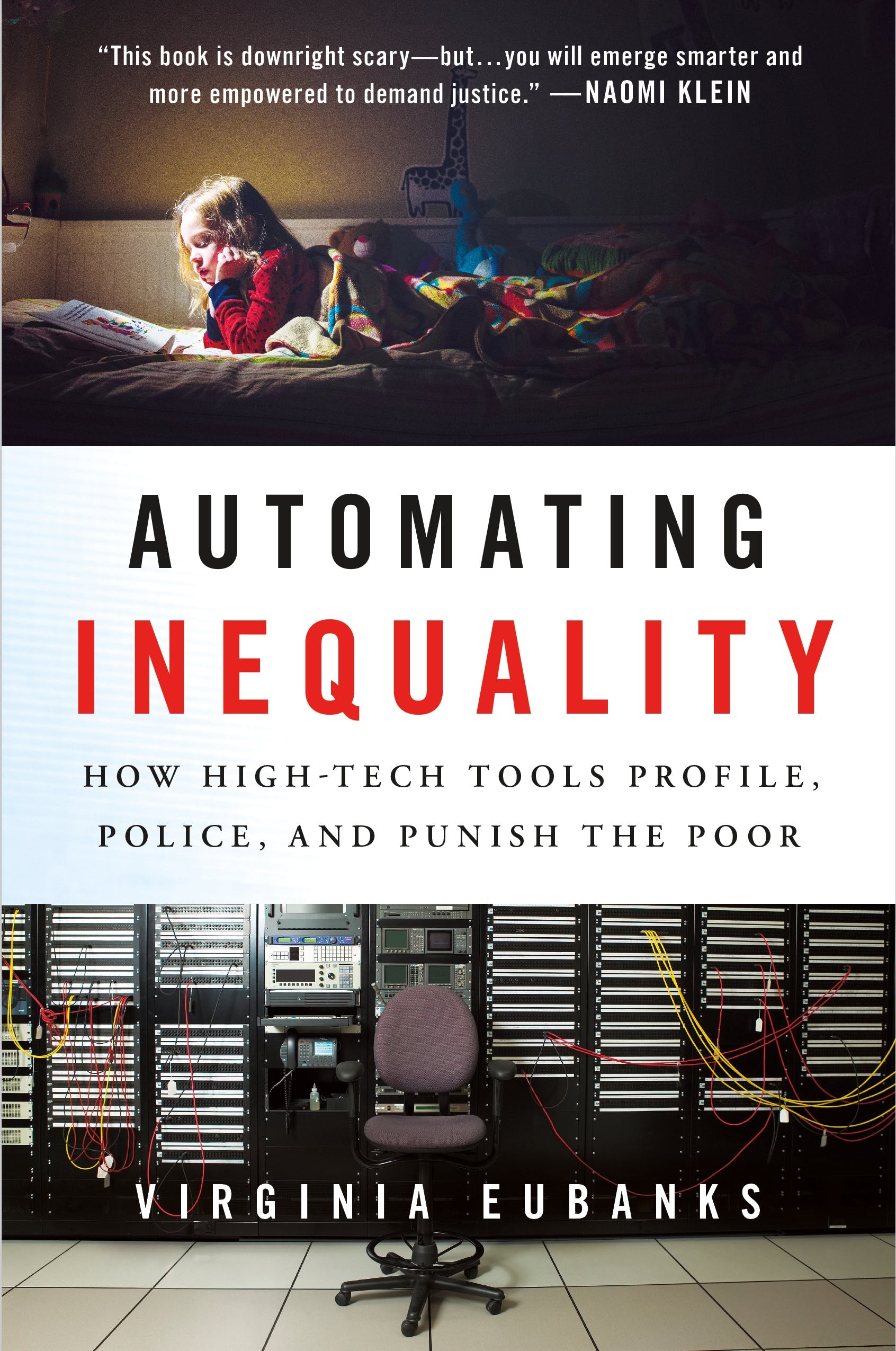
Automating Inequality: How High-Tech Tools Profile, Police, and Punish the Poor by Virginia Eubanks

        I am currently racing against the clock to catch up on all of my remnant book reviews for the year. The temptation presents itself: could I just post an AI review of Virginia Eubanks’ Automating Inequality: How High-Tech Tools Profile, Police, and Punish the Poor? Of course not! If you’ve learned nothing this year from the non-fiction reviews I’ve been posting, it’s that there is significant reason to distrust the automation of thinking, and really, I would be going against the central premise of Eubanks’ book: we need more human intervention, not less.

In Automating Inequality, Eubanks outlines the ways in which technology is used to, essentially, engage in social engineering. The books is a mix of testimonials, public record, anecdotes, case studies, and histories to explore the ways in which the increasing automation of public services has actually served to reduce services and potentially replicate—even exacerbate— the problems the state claims to want to reduce. She makes her case with reference to three main places: Los Angeles, Indiana, and Allegheny County in Pennsylvania. The approach allows her to see both the forest and the trees with respect to big data and social services.


Overall, the book was somewhat illuminating, but maybe leans a little too heavily on the particulars rather than the broader systems that motivate the transition to so-called “modernization.” I place the phrase in quotation marks, because as Eubanks notes about Indiana, the attempt to have IBM “modernize” social service programs ultimately resulted in worse performance and worse access. The situation became so volatile that IBM and the State of Indiana sued one another. The State claimed that IBM misrepresented their ability to modernize complicated social service programs and that they did not meet the expectations outlined in their contract while creating a falsely aggrandized perception of its performance. When comparing counties that used more traditional means of providing social services against those that IBM “modernized,” automated counties reportedly “lagged behind in every area of performance: timeliness, backlogs, data integrity, determination errors, and number of appeals requested.”


It’s oddly satisfying knowing that IBM’s attempt at a privatized technocracy over public data did not meet its own ends, but the case gets even worse because of its human impacts. Purportedly, IBM’s “coalition workers were so far behind in processing applications that they would often recommend denial of an application to make their timeliness numbers look better but then would tell the applicant to appeal the decision.” It’s an instance of numbers being cast as more significant than the humans that the figures actually affect. Prior to this moment, Eubanks discussed how difficult it was for people to access services. Services might be declined by failure to send in a particular form or sign on a particular line: any kind of minor error might result in a denial. However, systems are often so overloaded that they refuse to tell you why your application for support has been declined. Imagine sending in all of your paperwork only to have IBM deny you, and not tell you why, because they can’t keep up. What they would do instead is deny you and tell you to appeal so that while you’re filing your appeal, they can catch up, process the application, and confer its benefits before the hearing date of the appeal. It’s a clear manipulation of the numbers at your own expense, which is pretty disgusting.


Obviously, corporate interests play a factor here because they’re trying to make money off of necessities, which harms people in the moment. Meanwhile, in Allegheny County in Pennsylvania, they developed a predictive model for administering child welfare and making screening decisions. The predictive nature of the model aimed to reduce the need for human agents to consult on cases. In each of Eubanks’ case studies (Indiana, Los Angeles, and Allegheny), she notes that their “technologists and administrators explained [...] that new high tech tools in public services increase transparency and decrease discrimination. They claimed that there is no way to know what is going on in the head of a welfare case worker, a homeless service provider, or an intake call screener without using big data to identify patterns in their decision-making.” The claim, first of all, exposes their ignorance: technology is never value-neutral. Removing human agents does not remove discrimination, though it does make it harder to trace. There’s any number of ways that biases creep their way into tech (cf. Algorithms of Oppression by Safiya Noble) and it’s naive to think otherwise.


In response to this philosophy, Eubanks offers a passage that beautifully encapsulates the problem. She writes the following:


“I find the philosophy that sees human beings as unknowable black boxes and machines as transparent deeply troubling. It seems to me a worldview that surrenders any attempt at empathy and forecloses the possibility of ethical development. The presumption that human decision making is opaque and inaccessible is an admission that we have abandoned a social commitment to try and understand each other.”


I think when it comes down to it, this is the heart of the issue. Human beings are allowing technology to alienate themselves from themselves. As much as people want to claim that AI is the future, it is not capable (in my view) of the ethical nuance human beings are capable of and will still rely on false metrics to make its decisions. The inversion of which of us is the black box is a nice metaphor for considering the importance of these issues: the more we automate, the more difficult it is to explain processes and ensure that people get the supports they need. Following the passage above, Eubanks quotes from an interview that puts it all in simple language: “I trust the case workers more. You can talk and be like, ‘You don’t see the bigger problems?’”. Accessing supports is already an accessibility issue, which is only exacerbated by including the mediating force of technology: where is an algorithm’s complaint department? Especially when we’ve decided it knows all.


Even in terms of the application of these services, we face problems. The Allegheny Family Screening Tool, the AFST, is designed to see the use of public resources as “a sign of weakness, deficiency, and even villainy.” The predictive model attributed a higher score to families that had accessed social services before, which meant they were under greater scrutiny and potentially unable to access support services. It disincentivizes people from seeking support and consequently increases the risk of abuse or neglect. Accessing supports leads to more scrutiny, which leads to withdrawal, which leads to lack of connection. It creates a perfect storm. In Eubanks’ words:


“Targeting high-risk families might lead them to withdraw from networks that provide services, support, and community. [...] The largest risk factors for the perpetration of child abuse and neglect include social isolation, material deprivation, and parenting stress, all of which increase when parents feel watched all the time, lose resources they need, suffer stigma, or are afraid to reach out to public programs for help. A horrible irony is the AFST might create the very abuse it seeks to prevent. It is difficult to say a predictive model works if it produces the outcome it is trying to measure.”


It’s pretty clear to see the way that social services intended to provide support are co-opted by systems in which we place blind trust (cf. The Technological Society by Jacques Ellul). It presents a larger idea about technology, as well: does it do what we want it to do? Or does it create the context for what we have already done? The last phrase in the paragraph above—that the predictive model creates what it is trying to measure—is the same ouroboros I struggle with with respect to generative AI. Services like Chatgpt can gather what has already been done and spit it out: no original thinking has been produced. As teachers are encouraged to use ChatGPT and teach children how to use it, I fear we’re making the outcome we wanted to measure. We lose faith in ourselves as a species so quickly that it’s pretty dispiriting to see the lack of genuine, original thinking. I fear that our use of technology is continually producing a vicious cycle. In Eubanks’ words again: “Human discretion is the discretion of the many: flawed and fallible, yes, but also fixable.” Meanwhile, for AI, “the automated discretion of predictive models is the discretion of the few.” Seeking, receiving, and providing resources all becomes more opaque, increasing the demand for a system to save us, which exacerbates the problem.


Moreover, Eubanks points out the degrading effect on real, living people. Predictive models and automation deny people their basic humanity: “poor and working class families feel forced to trade their rights to privacy, protection from unreasonable searches, and due process, for a chance at the resources and services they need to keep their children safe.” These benefits ought not to be mutually exclusive. People should be able to obtain what they need without being scrutinized (especially when you consider how “welfare fraud” is a comparatively small sum in the grand scheme of things). Instead, we engage in “poverty profiling” and target people not based on their actual behaviours but their characteristics (i.e. living in poverty). In yet another effective turn of phrase, Eubanks notes that “the model confuses parenting while poor with poor parenting” and that “the AFST views parents who reach out to public programs as risks to their children.” Essentially, if they accessed services, they get a higher score, which means Child Services is more likely to respond to calls about their home (however unfounded), and then is more likely to return again and again on subsequent calls. Those who dare parent while poor face the state’s punishment.


Ultimately, Eubanks’ book is illuminating in several ways and offers some effective case studies for showing the problems of automation. I wouldn’t say this is the masterwork on automation, but it is a good example of how big data has real-world implications. Now all it needs is a follow-up book in which Eubanks examines the tools for dismantling our impulse towards automaticity. There are so many factors that run parallel or are interconnected when it comes to society and technology that placing these social services within a broader framework would prove both illuminating and useful for moving forward productive, but moreover, more humanely.


Wishing that you may all access the services you need while falling free from the algorithm—don’t forget to help others escape its clutches, too, and demand that public and social services be offered fairly to all those who need them. We can do better.