Search This Blog

Showing posts with label teaching. Show all posts

Saturday, February 21, 2026

Freedom Teaching by Matthew Kincaid

  Matthew Kincaid asks teachers a powerful question: “Do we believe that our students deserve to be in anti-racist environments 10% of the time? 20%? 50%? What percentage of racist policy is it okay for a student of colour to have to navigate on a daily basis?”

He follows it up with an even more powerful question: “What percentage of racist / oppressive policies are we comfortable with students existing in on a daily basis? Is the answer still truly zero?”


I find these two question sets highly provocative. For the first set, Kincaid points to the obvious answer: “in an ideal world, [it] would be 0%” while recognizing that “that is not the case.” The second question points to a fundamental disconnect between our ideals and practicality. While our students deserve to be in anti-racist environments 100%, nonetheless there’s a level teachers are able to accept for the sake of the system; it’s not complacency, necessarily, but there are a number of engrained practices that go unchallenged for a number of reasons.


This is where Matthew Kincaid’s Freedom Teaching comes in. In the book, Kincaid elucidates a liberatory philosophy that strives to make the educational world a more equitable place. I found the book to be thoughtful and empowering and Kincaid addresses a number of concerns that I am still grappling with, offering a framework within which to work. The book offers a balance between offering principles of freedom teaching while recognizing that the individual context of particular schools will have an impact on how the principles are executed.


Kincaid offers the following five tenets of freedom teaching and the book explores how to achieve these different ambitions:


  1. Maintain hope that is radical.

  2. It isn’t rigorous if it isn’t relevant.

  3. Free minds, free kids.

  4. Trouble doesn’t teach.

  5. Cultivate a classroom that values cultural wealth.


I think that #1 can be a particular challenge, given the current context in which we exist. The government is underfunding public schools out of existence. Artificial Intelligence systems are eroding our relationship to truth and imposing a hegemonic perspective of so-called reality. Politicians are engaging in corruption with impunity. Social media is sapping the uniqueness of kids. There is a lot to find troubling, so having the first tenant be to maintain hope is both a necessary precondition and the kind of thing that can only be achieved through a leap of faith.


The second tenet, “It isn’t rigorous if it isn’t relevant” hits like a suckerpunch to the gut. I think about all of the so-called rigour I was subjected to as a student, and while I don’t regret it, I do wonder why reading six books instead of four and writing three essays instead of two is seen as “rigour.” The deeper point that Kincaid is making here, to me, is that being “rigorous” (i.e. challenging) for the sake of adding challenge is not the same as being rigorous by delving deeply into content that is truly meaningful to students. Kincaid adds to the discussion with more detail. He sees rigour and investment as working hand in hand: “Students are less likely to engage in rigorous tasks that they are not invested in, and tasks that are rigorous, that don’t promote investment, probably aren’t meaningful tasks.” As much as I hate having to justify the value of English as a discipline, it is worth considering how to get students invested in developing their writing skills. Whether that’s the content or the end-goal, there needs to be some reason for students to get invested. 

In terms of #3 and #4, I think we are in a particularly reactionary climate wherein the response to children misbehaving is to resort to more policing. By freeing students’ minds to explore and question, we enable their ongoing success in navigating and challenging societal structures. All of this also leads towards cultivating a classroom that values cultural wealth, where a teacher’s role is not to impose a particular view of how to best navigate our lives, but instead to co-create with the communities in which we operate. A noble goal, indeed.


Ultimately, these tenets have the goal to “create educational environments that liberate students and in turn enhance their ability to make choices that give them control over critical elements in their lives.” I think it would be uncontroversial to accept this as a worthwhile pursuit. If our education isn’t assisting students towards being agents of change in their own lives, what is our purpose, exactly?


As I mentioned, Kincaid makes the case that “freedom teaching requires investment in both theory and practice.” Indeed, it is “about finding the intersection between theory and practice.” The author gives a caution for the book: “Using this text to provide a theoretical framework without engaging in the practice of employing the techniques likely won’t yield the results you want. Engaging solely in the practices without internalizing the theory also will yield incomplete results.” I think this is one that gets challenging for people in the teaching world. We are all so busy, so exhausted. We want to be told “do this” and we’ll do it and fix the world. But, the work is complex and requires examining how our particular practices need to be thoughtfully adjusted in response to the context. As Kincaid points out, “One of the reasons why anti-racism initiatives in schools fail to gain continued momentum is because people find themselves so deep in the theory that they don’t know how to apply it in a practical setting. On the other hand, there are people who [adopt a] three-step guide on how to achieve equity without fully understanding the deep and nuanced theory that provides the foundation for those practices.” I’d like to think I’m somewhere in the middle, but if I truly reflect, I’m more on the theoretical side and still need practice actually acting.


Here’s the other major piece that I think Kincaid has identified in a particularly poignant way. One of the things I’ve seen is people enacting performative change and taking credit for how much they’ve made a difference—but maybe unjustly so. Kincaid writes that in his work with schools, “one of the most difficult barriers to dismantle is the barrier of performative change.” He makes the case that a school might eliminate a racist policy without replacing it with an anti-racist one. He gives a great example here where “a teacher changes the names on their word problems to be culturally affirming, but doesn’t shift their pedagogical approach in the classroom.” I’ve witnessed this kind of thing first hand. As we work to select books that are culturally affirming (i.e. change the content), we make no adjustments to what we do with those texts: we still impose, generally, a prescriptive structure of how to write, what to write, what to write about—all under the pretense of being “academic” and “objective” without valuing individual student voice. Changing the content without changing the form still serves to replicate the structures that are leading to undeserving students. Kincaid elaborates that “a school district undergoes anti-racism training, but does little to shift the policies that incubate racism.” When this happens, the change is superficial—”the very changes that we are championing can actually just reaffirm the status quo.” I couldn’t begin to list the number of so-called changes that have had this effect. The solution, Kincaid writes, is that “if we are going to invest the time, energy, and resources to freedom teach, we have to be committed to doing it all the way. If we are going to be committed to doing it all the way, we first have to train ourselves to believe in, and hope radically for, change.”


In trying to accomplish a truly revolutionary approach to education, there are a number of limiting beliefs that Kincaid addresses. One thing that I hear from teachers—and society at large—is that students need to be ready for “the real world” (by which, in my view, always seems to mean ‘the workforce’). In this conception of education, the purpose remains to reinforce the structures of capitalism. (Why is it that companies don’t pay to train their own employees, again? Why is it that public funds are being used to train employees for private companies? I digress.) Kincaid reinforces my view about the foolishness of the ‘real world’ as a standard for our practices through a slightly different angle: “I have witnessed the justification of several unjust systems because ‘students have to get ready for the real world.’ What this basically amounts to is exposing young people to traumatic experiences in the name of preparing them to navigate the brokenness in our society.” I think about things like holding students to strict deadlines and then deducting 50% of their mark, for example, if they hand something in a day late. I think about things like forcing students to answer questions in front of the class without time to prepare because ‘that’s how the real world works.’ Underlying these practices is the idea that somehow school is not “the real world,” despite students spending most of their time in our buildings. Schools are “real world” and when we defer to some monolithic conception of the real world in the great beyond after graduation, it automatically renders schools second-class to whatever idea we have of post-school. The other objection is one Kincaid takes up: “Freedom teaching instead views the world as malleable and teaches students that they have a say in the real world that they will both shape and inherit.” Teachers and students shape the world, so we have the freedom to shape the world we want while the students are in school to prepare them for the world they’ll want to create. In Kincaid’s words, “Freedom teaching is about creating schools that reflect the society that we want our students to live in rather than reflecting the society that currently exists. For this reason, this book will speak directly about replacing oppressive systems with liberatory ones and expanding the definition of what we consider to be success to include a culturally sustaining education for all children.” I think this, too, is spot on to how I want to approach teaching as I move forward in my career.


The challenges to Kincaid’s philosophy come in the form of limiting beliefs. He enumerates a range of perspectives that shy away from radical hope and instead instill a pessimism towards liberatory practice:


“This isn’t the real world. We need to prepare students for the real world. Culturally responsive teaching practices aren’t going to raise my test scores. Restorative approaches let students off the hook when they misbehave. All of this work that I am doing to make change isn’t going to amount to anything. I do not have enough power. If only I were the principal or a district administrator. I want to engage parents, but I know what is best for their children.


I think about my other recent read, One Day, Everyone Will Have Always Been Against This by Omar El Akkad. In that book, he talks about how youth movements and minor protests are never taken seriously at the time of their enactment, but then lead to the kind of long-term change they seek and we revise our historical memory. I think the same is true here; we could counter these limiting beliefs by taking small actions and moving forward incrementally, even when it seems like it isn’t making a difference.


There’s been discussion in the last few years around the relative merits of diversity, equity, and inclusion in the workforce. Under it, there’s an implicit racist assumption that Black people just aren’t as good as white people at being, say, a pilot (cf. I think an old Charlie Kirk clip, I think?). There’s the suggestion that DEI leads to a lowering of standards, but as Kincaid points out, “The absolute worst thing we can do in the name of anti-racism is to stop challenging our students.” Kincaid recognizes that the United States are far from being a meritocracy, but still points to the ongoing value of hard work, focus, and determination—esepcially for people of colour who want to have “a full array of choices for what they do with their lives.” This is why rigour is still encouraged (as long as it’s relevant). Kincaid notes that “we push our students to engage in rigorous tasks because we believe that they can do them. Consistently lowering rigour just reinforces external messages of inferiority.” Returning to a previous point, though, rigour without purpose—“rigour for rigour’s sake”—”can have the same detrimental effect.” He notes that having students repeatedly do hard things over and over without allowing them to experience success is a recipe for disaster. 


Implicit throughout Freedom Teaching is an asset-based mindset towards students. On the topic of whether students can do hard things (i.e. persevere throughout rigorous tasks), Kincaid notes that


“Our kids do hard things all the time. For some of them, just getting to school on a daily basis is hard. Caring for your younger siblings while your parents work is hard. Navigating the devastating effects of institutional oppression is hard. I don’t know if I ever taught a kid who couldn’t do hard things. In fact, many of my students had done more hard things by the time they were 13 sitting at one of my desks than I did in my entire lifetime.”


I think that’s a really positive note to consider. We are always pushing students for success; it would just be great to have a broader conception of what counts as success as we try to help everyone rise to their potential.


Overall, Freedom Teaching is a great outline of some principles that can help us to guide our teaching practice towards something more liberatory. I hope that we’re at the stage where we can incorporate this work and make significant change. I’d like to guarantee that we’re all that stage, but I know there’s still more work to be done. But we’ll do it. We’ll make it.


Stay optimistic and happy reading!

Tuesday, October 3, 2023

Teaching Reading: What Every Secondary Teacher Needs to Know About Reading by James and Dianne Murphy


Allow me to let you in on a little secret in education: even the uncontroversial is controversial. Even slight changes in pedagogy can cause an uproar, partly because the philosophies of teaching and learning are so nuanced, partly because the political and economic structures in which we function disincentivize change, whether it’s the imposition of goals from above, or overloaded class sizes, or being denied the time and resources to plan for and implement change…the list goes on.

    And yet, there are practices in education that require a substantial overhaul. This was made dramatically obvious with the release of the Ontario Human Rights Commission’s Right to Read report, which demonstrates that the strategies teachers have used to teach children reading over the last twenty years have been at worst detrimental to student learning and at best successful for some, but ultimately inequitable.

    It is in this context that I read Thinking Reading: What Every Secondary Teacher Needs to Know About Reading by James and Dianne Murphy. In most ways, the text is as uncontroversial as is possible—but it will certainly seem to be.

    Often, educational texts begin by outlining a history of a certain pedagogical approach or a lengthy theoretical backing for a cluster of approaches. Such is the case for works like Cultivating Genius by Gholdy Muhammad, which gives a long history of Culturally Responsive and Relevant Pedagogy through the lens of Black history and instructional practice. Other texts offer specific strategies for instruction and leave it to your imagine how to implement them in books with titles like 101 Teaching Strategies. It is always my hope that texts will provide teachers with specific practices to help support teaching, or at very least a balance of theory and practice. Kelly Gallagher’s Write Like This: Teaching Real-World Writing Through Modeling and Mentor Texts stands out in that respect as a great balance of theoretical and applicable.

    In the short span of Thinking Reading, the authors err on the side of historical and political context, which does prove illuminating—for instance, the fact that 20% of students cannot read at grade level is an alarming statistic. The Murphys do offer some strategies in the middle of the book, but the details often remain hazy—including on a very particular point that I’ll address in due course.


    First, though, let’s discuss some of the helpful frameworks the authors provide for learning. For instance, they outline the stages of learning, and the actions teachers need to take at each stage, to ensure learning:


  1. Acquisition, where teachers offer “unambiguous presentation with guide practice and immediate feedback” (121).


  1. Accuracy, where teachers offer “continued, spaced practice with a high accuracy criterion (usually 80%-100%)” (121).


  1. Fluency, where teachers offer “daily timed practice with carefully sequenced practice materials to a high rate per minute” (121).


  1. Retention, which involves scheduled review in a “spaced retrieval” (121).


  1. Generalisation, where students “practice in adapted contexts or in combining the target skills with other previously learned skills” (121).


  1. Adaptation, where teachers offer “opportunities for independent, creative problem-solving” (121).


Thinking Reading presents these parameters as a guide for reading, but I think this framework for mastery is worth considering no matter the discipline. It’s also worth considering how this might revolutionize lesson design. For at least the last fifteen years, we’ve been encouraged to apply a model that is Minds On → Activate Learning → Consolidating Learning. Alternatively, a hook, the lesson, the evaluation. While I’m missing the specific page references here, James and Dianne Murphy advocate for about 70% of each lesson to be review of previous material and only 30% new. This helps students to develop confidence and competency. They also go against the grain somewhat in suggesting that the most fun and engaging parts of the lesson should be placed after the deep learning as a reward for students mastering their knowledge. This flips the entire script of beginning with a ‘hook’ to tempt the students into working. These suggestions would radically change how I structure lessons towards mastery: Review, review, review, little lesson, something fun, something fun.


    One thing that’s a little unclear to me is their conception of repetition. They give an example partway through the book that leaves me perplexed. They say that you want to have students practice and review content most of the time. Then, they say, “Repeated quiz questions do not have to be the same every time. For example, the following three questions all require the same knowledge from a student of geography:
-What is the longest river in China?
-What is the third longest river in the world?
-On what river is the Chinese city of Shanghai?
In this way, the quizzes repeat the testing of knowledge without being repetitive” (79).


I’m not exactly sure how the three questions “all require the same knowledge”. To me, it implies that you’d need to know things about rivers in China but also the rivers of the world and also knowledge of cities in China. I’m not convinced that a student would be able to answer all three of those questions with the same bit of knowledge.


    Anyway, in a number of ways, the science of reading work that is now becoming re-popularized is aligning well with the culturally responsive and relevant pedagogical learning that is happening, too—it makes perfect sense, since both are rooted in equity work. There are a number of adverse effects for students who are unable to master reading, including increased bullying, poor self-esteem, lower wages, and so on. For society, the effects are estimated in the billions for underfunded literacy programming. The book outlines some premises that prove helpful for reconsidering attitudes towards students. They identify the reification of literacy problems (and dyslexia) as having the following effects:


  1. “It places the locus of the problem within the child, not with the instruction.

  2. It releases teachers and schools from accountability when a student has not learned.

  3. It provides an explanation for the child and their family that is understandable, and which can become part of a positive personal narrative about overcoming disability.

  4. It can be used to lobby for additional funding and resourcing for the student. This advocacy work assures schools and parents that they are doing their best for their child.” (43).


I find these observations astute and force us to reimagine our role as educators, especially with respect to instruction and assessment. In terms of its alignment with culturally responsive and relevant pedagogy, we can see the correlation in that both strive to promote identity, skills, intellect, criticality, and joy through high expectations. The Murphys refuse to lower reading expectations, which I admit I’ve been guilty of for students that really struggle. They note that “in the past, school curricula have sometimes been under pressure to reduce demands on students because they did not have the necessary cultural knowledge to deal with more sophisticated or challenging texts. The cumulative effect of this process was to disadvantage those who were already disadvantaged by a lack of relevant knowledge” (95). When students are ‘reading to learn’ (rather than ‘learning to read’), students at the receiving end of the service gap have often been given less challenging texts—fluffy stories and articles. There’s an assumption that because they can’t comprehend text well, they can’t comprehend issues—which is something we’ll continually need to fight against. Of course, text needs to be at students’ reading levels lest they get too overwhelmed and disengaged, closed off to learning. 


    The whole goal here is to make reading automatic: “what seems like attention to context and visual cues is actually the luxury of thinking about what we are reading – created by the automisation of decoding” (35). Framing it this way, it makes sense why students have historically had such a hard time articulating what strategies work for them and why. Yet, given some political changes and funding that verges on the conspiratorial, teachers for the last few decades have been teaching reading through methods that are largely ineffective, including practices like predicting words based on a first letter and context clues. In many ways, what the Murphys advocate here is a return to phonics. One of the disappointments for me with this text is that the it continually gestures towards high-yield Direct Instruction reading strategies, but never fully delineates how the system is achieved. I think it would have been worth the extra 50-100 pages to explain how it all works.


    Instead, there are some small, specific tips that pop up throughout the text that I’ve already begun to implement when teaching, for example, poetry. One of their recommendations is to ask students whom “he” or “it” refers to in a sentence because it can “reveal quite alarming gaps in their comprehension” (74). Even in grade 12, I can say, it sure does. They also recommend providing instruction in the structure of words, which I’ve been continuing to reference in incidental ways. They also offer phrases that help encourage students to attempt and not ‘opt-out’ of learning, like telling students, “I’ll give you a minute to think about that and you can try again” (78). As they outline their habits for instruction, they note that their approach is characterized by the slogan ‘low threat, high challenge’ (78). The mantra demands that “For struggling readers, this means confidence that there will be opportunities for them to try things that they might fail at, that they will get reliable corrective feedback, that this will be low key, and that, even in the case of errors, their status with the teacher will be undiminished” (78). It’s a good framework for teaching reading, but also just for being an effective teacher.

    A concern that comes up for me with texts like this is when classroom practices come across as utopian, derealized from classrooms. Surely they’re targeting some strategies to a younger, elementary audience, since there are things that will just not fly in a high school context. For instance, they suggest that when students are reading to themselves, you circulate around the room (“while keeping an eye on the rest of the class” (73), of course). They suggest that you have them read aloud to you (“Most students love reading to their teacher, even those who are not confident about reading aloud to the class. Giving them an opportunity to read with you is a gift” (73-74)—I’m skeptical on that one…) and that “as they read, note down the errors they make. Are they recurring, indicating a knowledge gap that can be taught, or are they inconsistent, suggesting inattention to details or a lack of fluency? Also, note how fluently and expressively they read” (74). It’s difficult to imagine mass buy-in where you’re reading over a child’s shoulder while they read to you AND you’re documenting every mistake they make in terms of engagement and demand, it seems a big ask as a regular classroom practice. I’ll try, but I’m not sure yet on how it would look. Thinking Reading reminds teachers to “always remember to praise what they do well, and to give two or three very specific items of feedback” (74), noting that “You can’t do this sort of exercise all the time, but if you have two or three students like this with whom you check in every week, it makes a big difference to them. And, of course, it is likely that they will improve, because they are getting specific feedback and, hopefully, they want to please you” (74).


    More likely is that you are able to “Set up activities where students read to each other in pairs” (74). They outline the practice as follows:


“take turns, and tell them that they can work out between them which parts each will read, explaining that slower readers should read less text, focusing on accuracy. Even five or ten minutes of such activities will provide not only much-needed practice, but also modelling from an able peer. Modelling is most powerful when it is provided through someone who is close to the learner in age, status, and skill level. Students will generally take more risks with a peer than they would with an adult. Co-operative learning strategies (structured pair or group work, with clear ground rules to ensure productivity) have a strong track record in the research literature.” (74-75).


The practice is well-founded, of course. It offers some good background, too, of how to establish partnerships. I’m not quite convinced yet, though, that high school students will be more successful when reading with a partner. Most of my students don’t even want to talk to one another, much less read—I can imagine myself saying “go” and there being ten minutes of uninterrupted silence.


    Some of these practices may not be quite effective in a high school context without first building school culture in particular ways. What we come to is a chicken-and-egg situation. To their credit, the Murphys recognize that students may be resistant, but they attribute that resistance to a lack of confidence with reading. I’d like to offer a longer passage that characterizes the dilemma:


“[Students] manage teachers in order to reduce demands in lessons — disrupting the lesson, disengaging from the work, or becoming personally challenging. All of these are consequences that are unpleasant and aversive for teachers. If, by contrast, in a lesson with no reading demands the students are much more positive and pleasant, then it is easy to see how a strong (though often unconscious) motivation arises for the teacher to reduce reading or academic demands. This issue has to be addressed openly and explicitly with students: reading is a part of every lesson. Once students realise that this is non-negotiable, and that they are enjoying the benefits of wider knowledge and a broader vocabulary, success begins to create a ‘virtuous circle’. But it may take a graduated process to establish such a system as part of the culture of the classroom” (77).


I think there are two key words here. The first is “non-negotiable.” The idea of there being specific, high expectations is maintained there. It’s very common to succumb to student pressure—everyone wants to be liked!—and to make tasks easier when they don’t do well. However, if we are to maintain the idea of high expectations, there are some things that have to be done. The second piece worth noting is the “virtuous circle.” On that front, it seems a little naive. I’m imagining my classes that are most challenged by reading—reading is not something “cool”, so it’s much more difficult to get students to recognize the benefits for themselves to be led; plus, I don’t think it’s all that likely that students will spontaneously tell each other not to be disruptive and have it work.

    Now, let’s delve into some of the more controversial claims. One that I find particularly troubling is that they essentially suggest that dyslexia doesn’t exist—which contradicts the ideas put forward in the Right to Read report. Teaching Reading suggests that people can’t read well, so they get diagnosed as dyslexia. What’s the evidence for dyslexia? That they can’t read. Rather than being an issue of brain wiring, the Murphys claim that with early and effective intervention, dyslexia can essentially cease to exist. It’s certainly a provocative suggestion. While I understand the rationale for their claim—their aim is to improve instruction over and above suggesting fault with students—I would never suggest to a parent that dyslexia is a misdiagnosis.

    A controversy I actually really value, though, is the way the Murphys envision literacy within the broader school community. A few years ago, a Learning Support Teacher role came my way where I was able to meet with students in small groups or one-on-one to support literacy. The school board has decided to go in a different direction with the Learning Support role and it has redirected all support into math instruction. That being said, I’ll leave some of the comments from James and Dianne Murphy here without much comment of my own. To support learning, they implore that “students may be withdrawn from any subject for effective reading intervention.” Their rationale is that “if every subject benefits from improved reading, and if reading is a whole-school priority, then it makes sense for every subject to contribute a little of the catch-up time some students need. The condition, of course, is that the positive impact of the intervention far outweighs the negative impact of withdrawal from classes” (94). That’s going to ruffle some feathers, certainly, because—at least in high school—everyone is in their own silos and everyone feels the pressure of curriculum demands. (Luckily, the literacy team at my school has the goal of decentralizing literacy!).

    In order to accomplish this, the Murphys also emphasize the importance of assessment. They note that all students at risk of reading failure need to be identified and helped, which can only happen if “the school commits to a thorough, systemic screening process [...] so that no student is missed” (94). This is also controversial in its own way since it requires A) that everyone agree to a particular means of assessment and B) the time and resources to do it. It also requires a level of standardization that inherently gets teachers’ backs up in defence of their professional judgement. That said, they note that “Many schools still rely on teacher identification when allocating support, and this is fraught with error, particularly because many poor readers have developed sophisticated ways of masking their reading problems – for example, disruptive behaviour, playing the class clown, fading into the background, or absenteeism. Thorough, objective screening, followed by prompt and decisive action, is required to ensure that all students are picked up and helped” (94). I think there’s something to be said for this, since there are so many unconscious biases teachers have with respect to what poor reading “seems” like or which students would benefit. I admit to it myself that there are specific ways that attitudes manifest in my mind about what effort looks like. Not only that, but there needs to be assessments like this because otherwise “the only other resource the school has is either to a standardised testing regime, which is far too imprecise, or to a referral system in which the teachers who push hardest get extra resources for their students” (91). I’ve seen that exact phenomenon more than once where teachers (and parents too) take advocacy beyond the bounds of equity and into the realm of ‘make my job easier by getting this student off my hands’.

    The trick, of course, is that any standardized approach can be dangerous. The concern is that standardized testing serves to rank and stream students (90) rather than to select strategies that would actually improve performance. In that sense, the recommendations in Thinking Reading and the Right to Read Report align that we all too often conceptualize the issue as students failing rather than admitting that teachers have failed students (not necessarily by their own ill-intent or negligence, but because the system has been constructed in such a way and has trained teachers in the use of ineffective strategies). 


    Overall, Thinking Reading serves as a nice, accessible primer for the issues surrounding gaps in teaching and learning with respect to reading. It offers broad strokes for a pedagogical framework that promotes reading. In terms of the particulars, the book is not yet quite sufficient for the needs of working teachers. There’s no implementation guide for teaching reading, which is a little bit of a downer. As I mentioned in the opening of this review, the book is as uncontroversial as is possible in a controversial field.


    Give it a shot, but I’d encourage some further reading to get a better sense of particular ways of actually helping kids learn to read good.


    Happy reading—it’s a gift that is best when shared.

Sunday, April 2, 2023

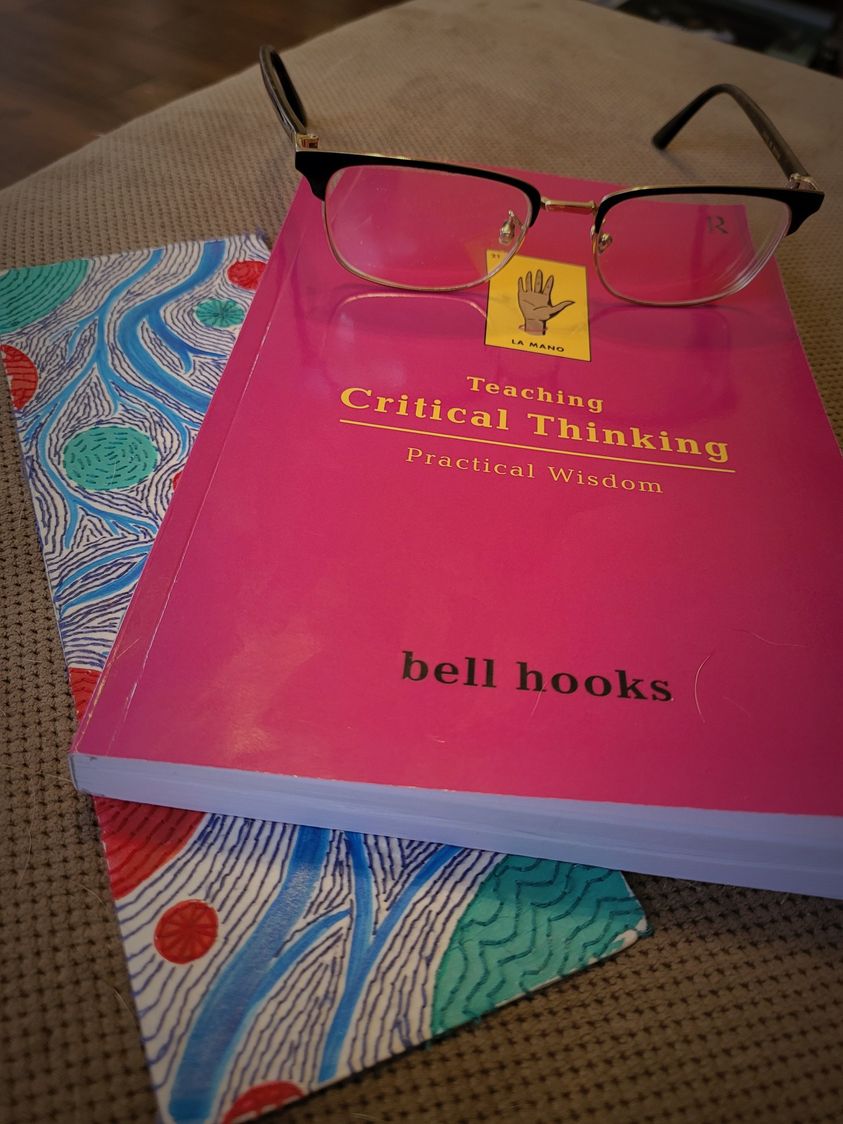
Teaching Critical Thinking: Practical Wisdom by bell hooks

    bell hooks is consistently an insightful person who is prescient in all sorts of areas while serving as an example for living to the rest of us. Teaching Critical Thinking: Practical Wisdom is a more education-driven book, but would certainly offer wisdom for everyday people, as well.

    While bell hooks’ work is always worth reading, the subtitle “Practical Wisdom” is a bit misleading for the teachers I imagine in the target audience. The book is essentially philosophy that sets the foundation for teaching and learning. One of hooks’ recurrent themes is that of love, which I find consistently inspiring and engaging. Drawing from Paolo Friere’s Pedagogy of the Oppressed, hooks discusses how important it is for teachers to be authentic humans with integrity and a love for their students. The spirit of compassionate understanding that drives all of her work, including her social justice work, is inspiring to me, particularly when tensions and divisions are so easily demarcated—and even recognizing it, I’m not immune to it (I dismiss pretty much all conservatives out of the gate), so it’s a helpful reminder of the greater sense of purpose we have and the methods that actually work to get there.


    hooks makes use of personal anecdotes and storytelling to great effect, especially in these tricky issues of social justice. For instance, one chapter is devoted to tears in the classroom. hooks talks about times that she and other teachers have cried. She then talks about times students have cried in class and, in particular, about times White students have cried in response to the injustices committed against Black people. The examples are instructive because, while hooks is always compassionate, she does not allow tears to detract from her sense of purpose in the classroom to guide the discussion towards meaningful critique. 


    To take a step back, Teaching Critical Thinking is an extension of hooks’ previous texts, specifically Teaching to Transgress. The books address similar concerns: engaged pedagogy, democratic education, a sense of purpose, integrity, the importance of storytelling and conversation, the role of the teacher and the intellectual in society, and so on. Teaching Critical Thinking is set up in 32 chapters, each of which is framed as a response to a question or follow-up to issues that arose in previous works. This means that one of the downsides of the text is that hooks recycles ideas, including quoting from her previous books. I suppose that’s the nature of academia, but it might have been nice to have some more original content here to justify a completely new text from Teaching to Transgress.


    That said, some of hooks’ most instructive and resonant essays appear in this book. There are two I’d like to discuss in particular as timely and insightful. The first is called “Learning Past the Hate.” In this essay, hooks recounts her love of Emily Dickinson and William Faulkner, delving in particularly with the latter, and the relationship she has with troubling works. The essay is beautiful. It documents her experience with Faulkner and how his work resonates with her, despite his racist and sexist insertions. The essay is a moderate one: its central thesis is essentially that even when books have problematic backgrounds, there may still be reasons they are worth reading and they may prove instructive in other ways. The essay then discusses how those books ought not be removed from classrooms, but rather be historicized (cue Fredric Jameson). Books like those of Faulkner can be instructive for their stylistic ingenuity or depth of feeling towards characters and so on; the problematic aspects can also be instructive in examining the historical influence of white supremacy, patriarchy, and so on on the text. I also appreciated that hooks notes how she would be much less sympathetic towards current books that voice similarly hateful attitudes. It’s a great balance that proves instructive for selecting texts for high school curricula.


    The other essay that resonates most with me as an English teacher is “The Joy of Reading.” While the essay is ostensibly about the importance of reading in our lives and the value it provides to nourish our spirits, it also provides an incisive critique of the aims of education. People generally have the perception of education as an instrumental good: it is worth being educated so that you can get a job and make money. That has and remains, in my mind, an inherently harmful viewpoint that makes people subservient to capitalism rather than as agents capable of critiquing it. Similarly, the low rates of literacy in the United States and beyond preclude meaningful participation in democracy. It’s a wonderful essay I’d like to share with my students to show why learning, reading, and thinking is so important as more than a simple instrument for wealth.


    Another component that I love about that “Joy of Reading” essay is how it intersects with Marxist sympathies and concerns. It actually evokes Walter Benjamin’s essay “The Work of Art in the Age of Mechanical Reproduction.” hooks talks about the associations of books and perceptions of wealth. She notes that “there was a time in our nation’s history when purchasing a book (rather than checking it out from a public library) was usually a sign of being a member of an affluent class or that one was striving to move from a lower class position” (130). She then talks about the abundance of reading material and mass consumption that has devalued reading: “this world of abundant reading material has not created a culture where reading books is the ‘cool’ thing to do. It has made it possible for more people to own a book, even to throw a book away” (130). She notes the way that books have been devalued as a commodity and how that feeds into an atmosphere of anti-intellectualism. If these reviews were illustrated, there would be an innocuous map of Florida inserted here without comment.


    Actually, it would be worth commenting on a passage that sets up the central ‘problem’ for the book that is likely to bring people together, though for backwards reasoning. hooks comments on the lack of thinking in society and its relationship with schools. She writes, “Most children are taught early on that thinking is dangerous. Sadly, these children stop enjoying the process of thinking and start fearing the thinking mind” (8). She continues, “By the time most students enter college classrooms, they have come to dread thinking. Those students who do not dread thinking often come to classes assuming that thinking will not be necessary, that all they will need to do is consume information and regurgitate it at the appropriate moments. In traditional higher education settings, students find themselves yet again in a world where independent thinking is not encouraged” (8).Taken out of context, the political right would likely find that a lot of that quotation resonates with them. The so-called ‘liberal’ indoctrination that they see so rampant at colleges would assume the same qualities that hooks identifies here, though each sees the critique from a different lens. The question, in some ways, comes down to what counts as thinking.


    As I’ve mentioned, bell hooks is well-versed in intersectional critique of the world. She considers students as whole beings, not shying away from their spirituality, eros, or emotional well-being. It’s quite common these days for the school system to focus on those who are most obviously struggling, but hooks helps to highlights concerns for even, and sometimes especially, high-achieving students. In one essay, she writes about “nerds or geeks, students who are often gifted at book learning, carry the residue of pain and trauma” (70). There’s a beautifully caring passage that follows regarding the relationship between trauma and academic pursuits. I’ll quote the passage in full here, but note the intersectional concerns with race, gender, and class:


“Many of us are simply emotionally numb, shut down, disassociated. I was not a fun girl at school or at college. Laughter, humor in general, was associated in my mind with letting go. My biggest goal in life during high school and undergraduate college years was not to let go, but to hold on–to keep a hold on life. Very little appeared ‘funny’ to me, and almost nothing was worthy of laughter. // When I entered graduate school, it became all the more unnecessary for me not to be seen as a fun girl. Striving for success in the world of sexist academia, a male-dominated environment where female students were told every day by professors that we were not really as good as men, made it all the more important to appear serious. It was important to be perceived as capable of doing academic work. When race and class was added to the equation, for a black female it was all the more vital to adopt a persona of seriousness. Throughout my college years friends and colleagues would often let me know that they would ‘sure like to see you drunk or stoned’ because they believed I was too serious, that I could have more fun if I just lightened up a bit” (70).


hooks then goes on to talk about bringing humor into the classroom and the vulnerability of it in the classroom. It’s a wonderful short chapter. Humor becomes a pathway to intimacy, which I think feeds into the idea of love. Essentially, that’s what it all comes down to: to teach is an act of love, and love is what compels people towards thoughtful care and is at the core of revolution.


    I’d like to close out this short review of hooks’ work by referring to one of the final essays in the collection. The essay is called “Moving Past Race and Gender” (note how moderates can likely find some middle-ground here). hooks responds to the criticism of her writing for a broader audience by suggesting that she remains as militant but takes an approach of reaching the masses “who are seeking life-changing theory and practice” (176). It’s an act of love to share learning with a greater audience. She concludes the passage with a statement that seems fundamental to her oeuvre: “Hence they will not understand that it is the most militant, most radical intervention anyone can make to not only speak of love, but to engage the practice of love. For love as the foundational of all social movements for self-determination is the only way we create a world that domination and dominator thinking cannot destroy. Anytime we do the work of love, we are doing the work of ending domination” (176).


    I hope I can carry that optimism with me in doing the work of teaching and learning and advocating for others. May we carry the patience, care, and genuine desire for everyone to thrive in the work that we do. Certainly divisiveness has its place (e.g. trans rights is a non-negotiable), but replicating the hatred that drives dominator thinking may not, in fact, get us anywhere.


    Happy reading—it changes the world, after all!